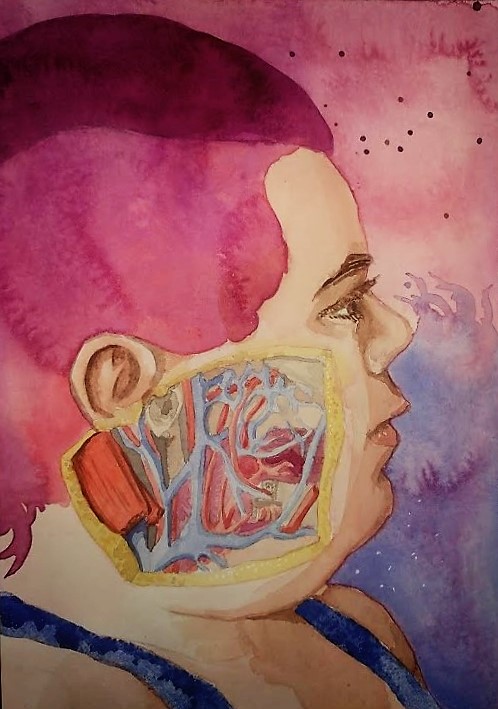
Left Middle – Watercolor – 7×10 inches – 2018

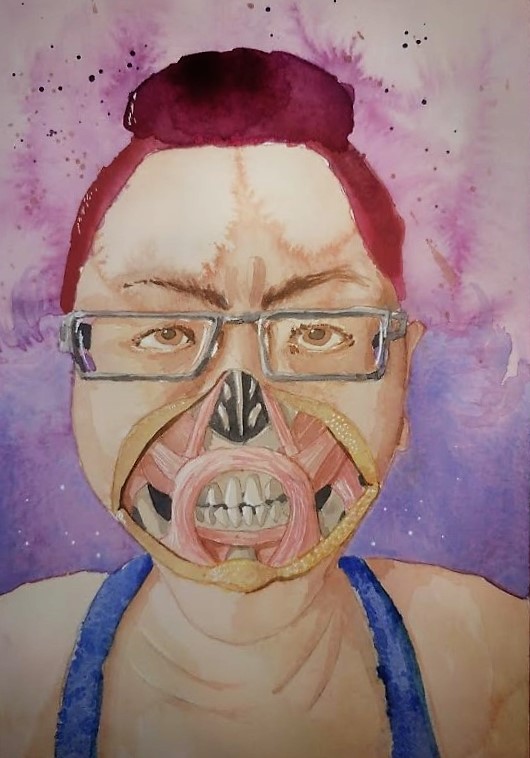
Center Middle – Watercolor – 7×10 inches – 2018

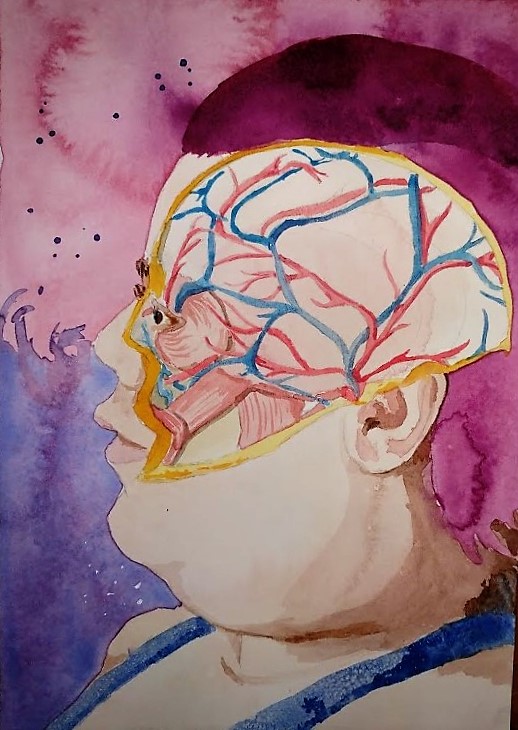
Right Middle – Watercolor – 7×10 inches – 2018


Most recent of the art I haven’t uploaded lately. I plan to start putting stuff up daily. I’ve also made a givinggrid donation page to help me pay for tuition. There are art rewards!

I’ve been doing a lot of art related to what’s (scientifically) under my skin lately. I intended this to be a 9 part series of medical diagrams that are all Brady-bunching around the central figure that stares at the viewer.

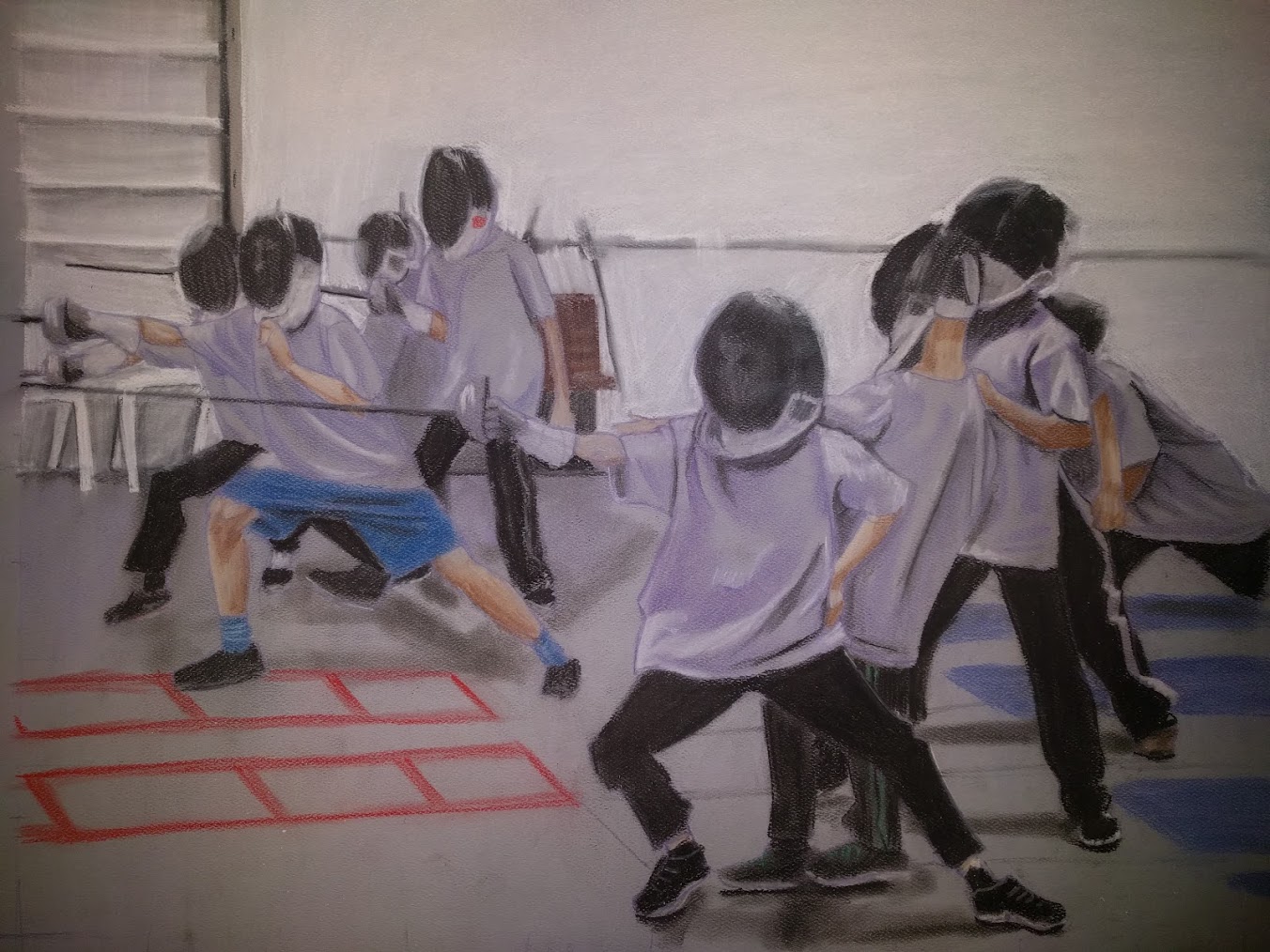
Fencing Practice – Pastel on Paper – 16×20 – 2017

More art I’ve neglected to upload. I plan to start putting stuff up daily or something close to that. I’ve also made a givinggrid donation page to help me pay for tuition. There are custom art rewards!

This is drawn from a photo of my son and the cub scout troop he is in at fencing practice. The boys in the picture are 8-10 years old, and that’s my boy Jonas in front.

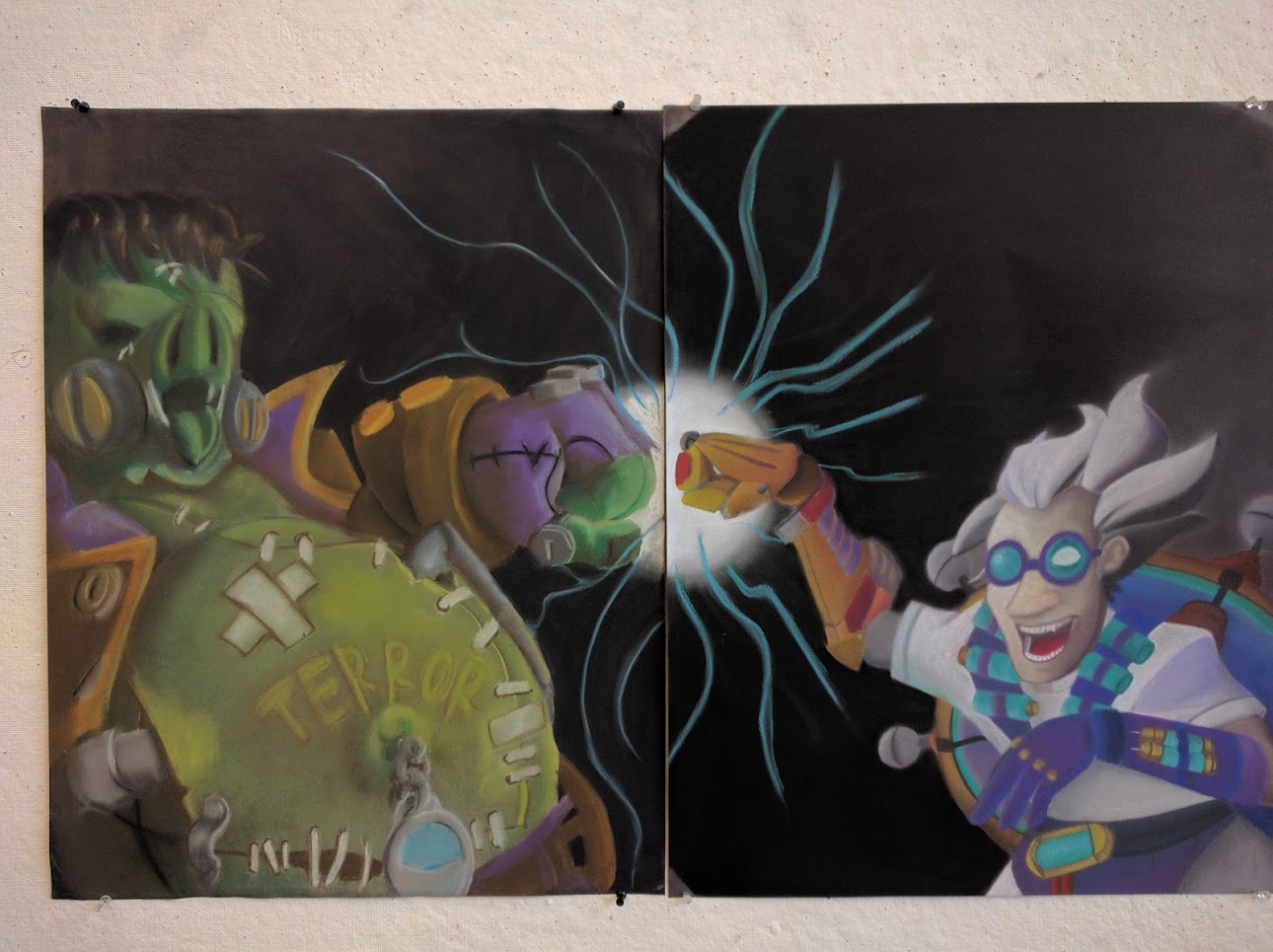
The Power of Friendship – Pastel on Paper – 2016 – Two 18×24 in panels
Left: Amanda Jurack – Right: Arnela Bektas

More art I’ve neglected to upload. I plan to start putting stuff up daily or something close to that. I’ve also made a givinggrid donation page to help me pay for tuition. There are custom art rewards!

This particular piece was inspired by the frienship fist bump between Arnela Bektas and I that was so powerful it caused others to comment on the shear awesomeness of it. We decided to work together and replicate it as Overwatch fanart with the two best bros of all time.

Arnela kept her side (Junkrat) and Roadhog is now hanging up in my son’s room.

ART – Veinity

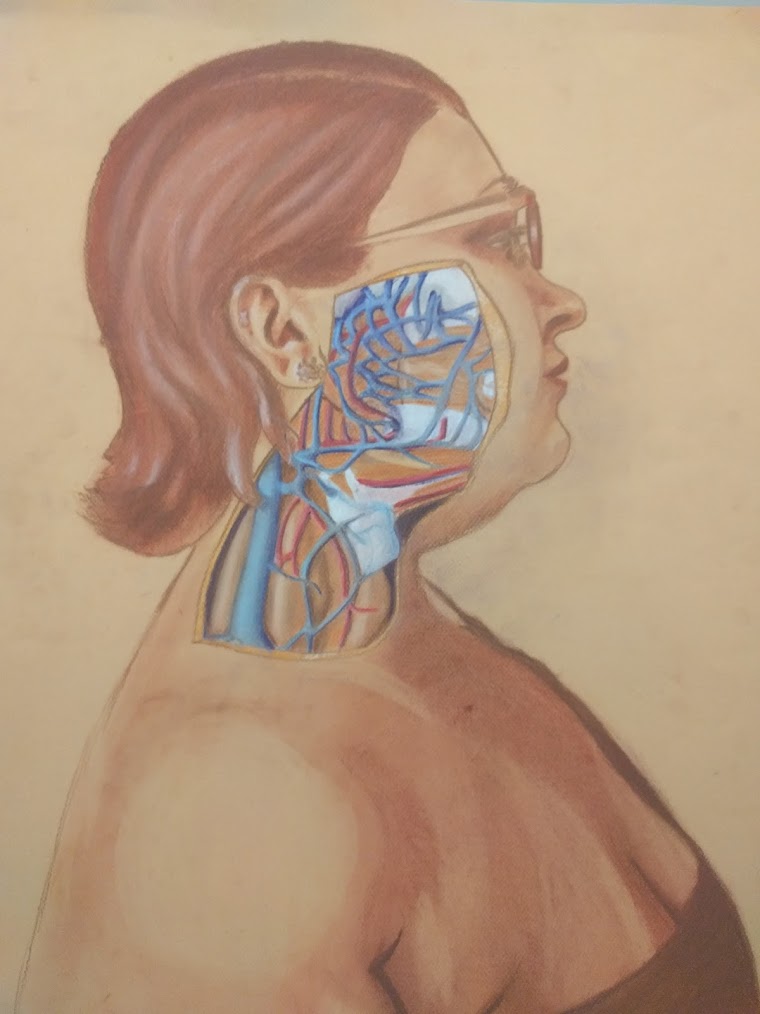
Veinity – Pastel on Paper – 18×24 inches – 2017

So here’s some art I’ve neglected to upload. I plan to start putting stuff up daily. I’ve also made a givinggrid donation page to help me pay for tuition. There are art rewards!

I’ve been doing a lot of art related to what’s (scientifically) under my skin lately. This piece is from last fall and was in a juried art show at Cleveland State University.

A quote from last week’s email from the professor for this course:

THINKING ABOUT BLOGGING

As we hit the midway point of this course, it may be valuable to you to blog about blogging: what is it like to write online about your writing, in this (somewhat) public way? Have you blogged before this course? Why or why not? How does knowing you are going to blog about these books affect your reading?


I said in a separate conversation with the professor that I’ve been blogging since before blog was a word. That may be a slight exaggeration. I have definitely been blogging since before blogging was a profession. The word blog, short for weblog, came around in the days of online diaries. The anonymous over-sharing that came around first on people’s private web pages, then on sites such as livejournal, myspace, friendster, xanga, tumblr, wordpress, facebook, twitter, and whatever else will come in the future. I’ve watched platforms come and go. I’ve watched online friends come and go. I’ve followed the lives of people I’ve never met, and people who have never met me followed my life.

Look at the side-bar. There are posts dating back to 2000. They were backdated on this wordpress (installed 2007) but have been part of my life, my site, since the 90s. I’m ancient on the internet. I’ve been making my views known to whoever will read them for 20 years or so. It was new then. I was a nerd for doing it then. It’s just part of life now. Not just for me, but for society in general.

The only manner that knowing I have to blog for this course (and for other course(s) taught by this same professor) is that how much of non-academic me do I want to let bleed into my writing?

  • I am used to writing academic papers.
  • I am used to writing blogs.
  • I am not used to blogging academically.
  • I am used to writing gigantic blustery papers that take ages to get the point.
  • I am used to writing short, witty responses to media I’ve consumed.
  • I am not used to writing short-form responses to things I have read for an academic audience. 

This has been a fantastic writing experience for me and I absolutely enjoy it. I don’t know how many people, if any, are really reading any of this (my site stats tell me it’s not many at all—my dealings with Valve’s foreign transaction fees continues to be my most read post). I can only hope that those who come here for my writing for classes stay and read my other writing (and try not to judge to harshly what 15-25 year old me wrote).

In her novel Future Home of the Living God, Louise Erdrich grasps and explains some rather important parts of the apocalypse: Humans known not the scale, and indeed prefer to not know (even with all their clamoring to just know), the scale of the end of life as we know it. The format of the novel as the main character’s journal gives the reader the fog an individual would have—unlike many others that offer flashbacks or other points of view that provide the reader with knowledge that the characters could not possibly know. When a global scale crisis arises, the people immediately become small-minded: looking out for themselves, their families, and little else. Those with power seize control of the military, communication, production, and reproduction. Their agenda is thinly veiled with euphemisms that imply comfort and protection, but masks the abuse of women. The abusers are themselves against what they do but have no choice themselves. No one is winning in this situation, even those that pretend to be in charge. It’s the end of the world, and no one wants to notice.

The focus of the book, however, is an individual’s journey in hiding from those in power, being captured, escaping, being captured again, and ultimately [spoiler alert] not getting away or what she wants. “Finally!” I said to my husband after I finished reading this, “A dystopic novel that doesn’t have a happy ending!” In most stories, there’s some morally gray “happy” ending that gets the main character(s) what they want but with some sort of sacrifice. Here we have a main character that loses everything, and remains that way at the end, with no hope in sight. This is what a reader needs in order to truly understand what the end of the world would be like. No one wins.

Several times within her journal, Cedar (the main character) writes about her future child’s growth, musing over the large numbers and small scale of each bit of growth. She admits that it all seems meaningless, but somehow important at the same time. Just like the end of the world—just like any other hyper-object—it’s too large or to small to comprehend, so she focuses on things that are her size. Her relationships with her moms, her dads, her sister, her grandmother, her “angel”, and the other pregnant women she meets along the way are what drives her. The crisis is endured by all, and so is not a concern that is discussed. It is there, all are aware of it, but every faction moves on their own for their own means. There’s no one group trying to save all of humanity, even those that they they are doing so are trying to create their own world.

The premise behind Dear Ijeawele, or a Feminist Manifesto in Fifteen Suggestions by Chimamanda Ngozi Adichie is what to do to raise your child a feminist and/or be a feminist while raising a child. Hot on the heels or reading Crispin’s so-called manifesto, I was thrilled to read something that actually added to the conversation of Feminism without just being an angry rant. Angry rants are for blog posts (see my previous ENG 363 for a prime example), not for printed publications. Those poor trees that suffered for Crispin’s independently published diatribe, may their spirits haunt Melville House for eternity.

My goodness does Adichie get it right; and by “get it right” I mainly mean she echoes what I already have decided is the best way to raise my child. She reminds her friend that she is more than just a “mother” and that “mother” does not mean “primary caregiver”. The first line that struck me and made me want to quote it is “The knowledge of cooking does not come pre-installed in a vagina” (15). Damn straight it doesn’t! I can’t cook for shit! Even with mail-order recipe and food services I still can’t cook! I do not have the mental energy or attention span to do it at all! My husband does all the cooking and I love him so much for it. We started our life together cooking “equally” but soon realized that doing half of the work drained more out of me than him, so we adjusted.

The suggestion to abolish/ignore marketed gender roles is an absolutely important one, and one I absolutely live by. My son has a dollhouse (which no one in the family would buy him for Christmas, so we bought it for him afterward) in which live action figures, Funko Pops, dolls, and papercraft Minecraft animals. He rarely plays with it now, but it was an interest of his for a while to have Anna and Elsa living in the house, Doc Brown in the garage, and Groot in the yard, and so on. While he may be embarrassed at school to mention these things, we remind him that not everyone realizes that children can be “as much of a boy or girl as they want” without ridicule, and so they likely ridicule their kids or condition them to be ready for ridicule. Like Adichie suggests for her friend’s daughter, we don’t measure our son by how much of a boy he is, we measure him on how much of himself he is.

Adichie’s “Feminism Lite” is given a short section in suggestion four, but it is an important one. The idea that men do, and women are “allowed” to do, is insanity. I do not work because my husband “allows” me, I do not create art or write because my husband “allows” it. I do it because it is who I am, and he is supportive of it (and as Adichie points out, “support” is what women do). I’m reminded of the phrase, “Behind every great man is a great woman,” because it implies that a woman should be grateful that she is supporting a man.

“Feminism Lite” also bleeds into much of the rest of the letter/book, especially in section six in which she says to question language. I’m reminded of an article from 1933 about Freda Kahlo, headlined as “Wife of the Master Mural Painter Gleefully Dabbles in Works of Art“. I can 100% assure you that I have never learned about Kahlo’s spouse in art history, but I have always learned about Kahlo as an accomplished artist (and, to point out, not as a “woman” artist, but an artist outright). I have a mohawk and dye my hair, I get tattoos. I sometimes get asked what my husband thinks of it (he loves it, though he would not do any of this himself) and I reply, “he helps me with the hair.” I do not acknowledge what they’re seeking to find, that he “allows” it or that I am “rebelling” against him, but skip to the implication that he’s fully supportive of me being myself. The most important take-away from this section, though, is “Teach her that if you criticize X in women but do not criticize X in men, then you do not have a problem with X, you have a problem with women” (27). This is something that needs taught not only to children, but to adults, to managers, to people in power, to the media, to everyone, everywhere. It is something that I sometimes have to remind my manager; I am a woman in a male-dominated field (as an aside, I am an artist and writer, but I am employed in an engineering role and do my job quite well). He may be enlightened enough to know that my gender has no bearing on my skills (just as my hair, my tattoos, etc. equally have to effect on my work) needs to listen to criticism from my coworkers about me and take into account that they may not be on the same level. Are they complaining that the behavior is wrong, or are they complaining that a woman has behaved that way?

I am glad that Adichie address the ideas of sexuality and romance as well as the shame and insecurity that come from discussing it. I see too often in feminist literature that these ideas are brought up, but not truly discussed. Relationships between two people, whether the heterosexual norm or not, should be about communication and mutual benefit. Femininity is too often about sacrifice and Feminism is too much about about not-sacrificing. Rarely does Feminism and Relationship discussion come down to actual interpersonal communication, authors opting more often to take an us-vs-them approach that echoes the misogynist viewpoints found in history. Turning a bad thing upside-down doesn’t fix it.

Adichie’s central feminist message for the child and mother is that “Be a person, a whole person, and do not define your self, your worth, or your choices by what society says you, as a woman, should do.” She doesn’t once tell anyone to “Just Stop” being a certain way, but rather accept that everyone come from a different place and has different hurdles to cross, and that their choices are their best choices. You can have opinion about things, but you cannot force your views upon someone – you cannot make them “Just Stop” as Crispin would love to be able to do. Adichie’s manifesto is much more useful for feminism, and for humanity. Though her background is far different from mine, her advise is universal.

“Why I Am Not a Feminist” by Jessa Crispin starts out like so many other feminist manifestos: a plea to not be treated like “every other feminist”. She takes it one step further by declaring she’s not like the other feminists that are claiming they’re not like other feminists. The conversation about feminism internal to the movement seems to be a bunch of accusatory navel-gazing that completely excludes everyone who is not actively trying to be a feminist. Crispin directly calls out that feminism can’t be palatable to the masses in order to make a difference in society, but then who is this manifesto for? (Hint: not me.)

The first section of the book makes me think of why I don’t identify myself with (as Roxane Gay put it) Capital-F Feminists—Crispin comes from a place of privilege where one can just stop doing things that are damaging to the feminist movement, whatever that may be defined as. This “Just Stop” mentality is great for people who can do it, but they seem to forget that not everyone is them, and not everyone can “Just Stop”. Just Stop, Just Do It. Easy words to say when you’ve got safety nets, maybe that’s why there are still “reluctant sisters”. WE KNOW OUR “ROLE IN THE WORLD IS FUCKED” CRISPIN. Crispin keeps turning to the second wave as what NOT to be and what has caused so many people to NOT be feminists now. Growing up there were many “hairy biker dyke” stereotypes in the media I consumed, but I never associated that with feminism (or Feminism), but rather with assholes who fought against feminism. Why does Crispin keep returning to this strawman? Is she so out of touch with reality? Or am I? Crispin is right to call out the identity politics of the feminism label, but this seems like a really flimsy argument. She claims the label of feminist has become so weakened by trying to be mainstream—so why does she care at all about the label (even so much as to put it in her title)? Rather than spend the entire manifesto railing on the weakened state of the label and naming names of people who have weakened it, couldn’t she have, instead, I don’t know, actually provided suggestions and insight into how to make actual change?

Section two … again straw man arguments and false dichotomy. She rails on a fictional other faction for not taking into account all aspects of a woman’s life but then fails to take into account anything other than her limited “feminists” and “traditional women”. She ends with a real good question: “Has feminism created the space for men to take on traditionally feminine traits at the same level it has created the space for women to take on traditionally masculine traits?” (35-36), but the question I’m left with is why did it take so many pages for me to get the point where I’m actually interested in what she has written? Feminism is about smashing the patriarchy (which damages both men and women) and she has only thus far focused on how the label of feminist has damaged women.

Section three opens with insults to Andrea Dworkin, who I had first heard of in this manifesto as Crispin’s strawman’s scapegoat. “Obese, frizzy-haired, without even a hint of lip gloss.” Congratulations, Crispin, you just insulted the majority of American women, myself included. But wait! That insult you gave is what the strawman says about us, not you! Please stop. Please. Crispin again advocates for “Just Stop” radical feminism. She calls the counter to her advocacy “Choice Feminism” – merely the act of making a choice (without a man) is an act of feminism. She addresses reality only slightly but quickly dismisses it with her “Just Stop” attitude. She addresses the privilege white middle class women have with “Choice Feminism” but conveniently doesn’t acknowledge that her own choices, specifically her choice to JUST STOP doing non-feminist things, is from her privilege as well.

Section four acknowledges that the problem is people and society, not men and women, which I am in absolute agreement with Crispin on. She advocates getting into the system and being a rebel rather than getting into the system and begin comfortable. This is what feminism should be, and what she’s been arguing against up until now. I could have saved 30+ minutes of my life just starting at section 4. Everything up to this point has been logical fallacies and poor arguments of an angry feminist; everything up to this point would have made me stop reading if I didn’t have to read the book for a class.

Section five is full of hypocrisy. Crispin calls out human nature to form the dichotomy (us-vs-them) but the first three sections of her manifesto were doing just that. Again, this manifesto would have been much better without those sections. The psychology presented in section five is sound and something I’ve thought before reading this book; people use projection to paint their “enemy” with whatever bad things they see in themselves. It’s easier to paint a strawman with bad qualities and claim to be “not that” than to acknowledge your own failings. I think in this section Crispin is projecting herself onto a hypothetical “you”, a reader she’s pleading for forgiveness from for her failings in the first part of the book. She set up a human nature that refuses to examine itself and then claims to be “not that.

In section five, Crispin brought up that no one talks about “toxic femininity” in the way they talk about “toxic masculinity” – I think that in that sense both are part of the patriarchy and the patriarchy is the problem. However, Section six talks about the revenge culture of feminism: this is the “toxic femininity” that needs to be talked about. Shouting down and destroying someone for disagreeing or for saying something disagreeable will have the desired effect of silencing dissent, but it silences all conversation as well. “Using the excuse that men have controlled and dominated the conversation for centuries does not justify using their methods to try and wrench control our way” (103). Crispin is clearly an advocate for humanism over Feminism, as this sort of outrage culture tears down the humanity of all, degrading “them” to nothing more than another label, and making “us” just as shallow.

Section seven solidifies that Crispin and I are mostly on the same wavelength when it comes to the manifesto portion of her manifesto. Everything before she got actually serious was garbage that was either included to pad her word count or to draw in those that might disagree with her in order to get them to read what she REALLY means to share. Or its just fomenting literature, as the first section of section seven is summed up with “fuck off men.” She again has a “Just Stop/Just Do It” attitude in regards to how men become/remain feminists, but then wants cooperation in building a new, equal world, where romantic love and relationships are not central to personal worth.

Section eight is entirely on one point that I live by (though not in her exact words) – “The way we deal with other people’s inhumanity is to insist on our humanity, not by insisting we are somehow a better, more honest version of human” (136-7). “Our job is to act like humans” (137) echoes what I often tell my son why we do things like consider what we say before we say it, consider our actions before we take them, and apologize when we make the wrong choices. We exist together for each other, everyone. Make it a good existence.

Section nine, if the casual reader ever makes it that far, is serious backpedaling from Crispin’s earlier stance that Choice Feminism Is Bad And Hurting Feminism. She again takes a “Just Stop” stance at the very end, but this time says “Just Stop” calling yourself feminist if you aren’t going to be a radical feminist. By stating in the title that she is not a feminist, Crispin admits to not being a revolutionary that can change the world, but then why write a book? “I’m a western white woman, listen to me!” but she has almost nothing to say. “I’m not like other girls” but then explains exactly how she is like other girls. She decries the injustices of the world and says “you’re all doing it wrong” but then also does it wrong. Then says “but we’re all human and capable of doing it wrong!”.

Crispin said some things I agree with, but not in some insightful, inspirational way that would make me raise this book up and say “Read! Read and be enlightened!”; especially when she devoted several pages to how men should seek enlightenment elsewhere. Yet she wants to rally everyone to addressing how the patriarchy fucks over all humans? But fuck off men. Not a fan of this lady.

ENG 350 – “The Road”

Last week I read The Road by Cormac McCarthy. To keep with my theme of comparing the novels I read for class to video games, I’d love to compare The Road to The Last Of Us (Naughty Dog, 2013), but I’ve never played the game. I only know its a zombie apocalypse game that focuses on the main character transporting a young girl to a safe location. Its a game I’ve meant to play but never got around to, and like The Road, the narrative is more about the relationships than the state of the world.

Though the class focuses on climate related fiction, I don’t feel that the situation in The Road is strictly climate fiction. It’s about the old fear of nuclear winter rather than the new fear of global warming. It focuses more on the powerlessness of the main characters at the hands of other humans than the uncaring universe. Don’t get me wrong, the uncaring universe is there, but it’s there for everyone. When something is so ever-present, it ceases to be a worry, and more of just a concern. A factor that must be taken into account rather than directly planned for.

In The Road, the man (who is never named, other than “Papa”) is entirely concerned with protecting the boy (his son, who again is never named). This protection ranges from tending to his physical needs (food, water, shelter) as well as his metaphysical ones. The man fosters a kindness in the boy that, even as the boy begins to call out the hypocrisy of the man, the man still insists the boy must adhere to. This echoes much of the world as is—”Do as I say, not as I do”—where people martyr themselves so that others don’t have to. It’s always wishful thinking in my opinion, as everyone must always survive, and protecting people in this way sometimes makes them unable to care for themselves in morally ambiguous situations.

The relationships between the main characters and other characters, however brief, are as important as the relationship between the main characters themselves. When two people have only each other, they can say whatever they want, but when a witness comes around, their attitude changes. The boy hints near the end that the stories the man told him about being the good guys are just that—stories. Lies. A mask the man wants to wear in front of the boy. But when others come around who are just as desperate, the boy wants the man to wear the mask, but the man knows the mask is flimsy and won’t protect them.

The end is “happy” in a sense, in that the boy won’t be alone, but we also don’t know his future. To truly be a dystopic story, though, I think the boy should have suffered alone longer. Not that I would wish that upon anyone, but the boy went from one protection to another—and honestly, when would that ever happen? Does it even happen now?

The readings for this week were the “Race and Entertainment” section of Bad Feminist by Roxane Gay and “Moving Beyond Pain” by bell hooks. One of my classmates touched on a point I previously hadn’t considered regarding these two takes on pop culture representations of race and women. There is a lack of diversity while being diverse. Shows with a diverse cast but not diverse roles are often lamented by actors of color.

I am reminded of the plight of new actors, which I’ve seen explained by Carolina Ravassa on her youtube channel Hispanglosaxon. While most of the episodes focus on her issues with being “too white to play Latina, and too ethnic to play white,” she also discusses on, when being cast to play an “ethnic” role she is often expected to play a hyper-sexualized service role (see season 1 episode 9). While shows may be casting people of color, they’re still casting them into the same, tired roles. Though it may be the entire cast (in the case of Lemonade), hooks laments that they are playing a stereotypical role (the body as a commodity in the background). With Orange is the New Black, there is a diverse cast (some latina, some african american, etc) they are all, still, some sort of criminal.

Jonny Cruz, another actor of color, in an interview at a convention was asked what to do when offered a role that perpetuates a stereotype. He admitted that he once took a role of a “thug” or “gangster” early on because he needed the work, but it made him feel awful. He knows he took the role because he needed a job, money, experience, etc, but he’s refused to do similar roles ever again. His advice for other new actors of color is to know that if you don’t feel right about a role, you do not have to take it. If you do choose to take it, you do not need to feel bad about perpetuating a stereotype so that you can eat. It’s a difficult position that the media puts minority actors in, but there is some solidarity and understanding in the actor communities.


BATIM BATIM BATIM BATIM BATIM BATIM BATIM BATIM BATIM BATIM

In my previous post regarding Edan Lepucki’s California I mentioned the symbolic “newness” of the turkey baster and the meaning Frida attaches to her other artifacts.  There are several times where objects—possessions—are triggers for memories or behaviors for Frida and Cal. These same objects, when handled by others, affect the characters. The Bee that Frida finds in Micah’s house meant so much to them as children and brings back pleasant memories for her, but to Micah it is just a tool. Micah understands what artifacts mean to Frida, though, and has August bring back her collection from the Miller Estate. But again, to Micah, they are just a tool to control Frida’s reactions. It’s entirely possible he left the Bee out for her to see. Micah uses Cal in the same way, but targets his ego rather than objects. He know Cal will be chuffed to part of the inner circle; to be let into a room that not even other members of the inner circle get to be in. He gives Cal/Gray an assignment on the inside to keep him in line; to make him feel special. He gives Frida/Julie all the objects of a “normal” life she could ask for.

I don’t particularly like that Lepucki echoed the stereotypes of men and women in the Land, especially after deriding such separations in earlier chapters. Frida willfully enters into “women’s work”; baking, cooking, gossiping. Cal continues with manual labor, security, and intellectualism. What does Lepucki mean to say about the end of the world, or the nature of humanity, by having her starring roles be held by such stereotypes? Even with Sandy, a pioneer through and through, she cared for the kids and did laundry and even pressured Frida to have a child. Bo did the hunting. The labor. “It’s about upper body strength” was used more than once in the novel to explain why Men do certain jobs.

While neither Frida nor Cal’s skills are presented as lesser than the other, the Land still has a clear distinction of how women work/behave/think and how men work/behave/think. Cal collected information from discussions. Frida, from gossip. Cal proved his worth by working. Frida, from bribery (with baked goods). While it could be said that these character choices are just these characters and how they would behave, that doesn’t explain the remainder of the population going along with the same ideals. The Men were in charge. The Men did security outside, the Women inside. The Women used sex to persuade Men. There were jobs that were co-ed, such as the construction, but the one woman in it was considered a shrew for wanting things measured. The men in cooking were considered inept.

My fear with any feminism class I take and any feminist book I read is that I’ll be beaten with the two-by-four of feminist rhetoric telling me how awful I am for not embracing the gold-star feminism of hairy-pits and man-bashing. It seems Roxane Gay has this same fear. While she starts the book with essays about herself, she goes on to discuss how pop-culture has skewed her view of feminism and how it could (and does) skew others’ views as well.

I am particularly taken with the essay “Garish, Glorious Spectacles.” I’ve long considered gender (masculinity/femininity) to be purely a performance. It’s an act one puts on to get responses. I’ve never been attached to either femininity or masculinity, having spent much of my younger years being told I was a “tomboy” for liking the things I liked and never really having much interest in the script for “girl”. My lovely housemate found that she also didn’t have much interest in the script for “boy” growing up, and now is finding that the script for “girl” doesn’t quite fit either (but moreso than “boy”). She revels in her ambiguity now, and as I told her I love seeing her happy, “You make others as confused about your gender as you are!” Gay’s readings of “Green Girl” et al affirm/confirm our right to be confused about ourselves by showing how the media portrays the “act” of woman. We know what we are, yet here is a popular TV show showing us what we say we are is not the definition they want to portray. The stereotypes of women are entertaining—an actual woman is human, normal.

Gay’s “Not Here To Make Friends” elaborates more on the stereotypes of women in media negatively affecting women in general. A woman who is portrayed as independent and bold is unlikable, but the same for a man is the ideal. Such it is in life – a woman in leader ship is bossy while a man is just the boss. The essay goes on to to say that it’s foolish to thing of a character needing to be likable to be a good character, man or woman, but a man often gets a bye as the “anti-hero”. A woman is just a bitch.

The opening of California (by Edan Lepucki) has been refreshing. Growing up with media such as Captain Planet and Ferngully, I’ve been inoculated against the over-the-top personal pleas for the average person doing what they can to fix whatever is wrong with the environment that week. If you, average American child, do not recycle that can, you are leading us to the environmental apocalypse! California acknowledges that the problem isn’t the average American—it’s the rich capitalist, the corporation—that’s causing the problems. It is, however, the average American that suffers.

Frida fawns over her artifacts, including the like-new turkey baster, as reminders of what life was before it began to end. Though as the story progresses, we learn that the end was already there. The irreversible causes had already had their effect, and it was just a matter of time before everyone felt them. Resources became more and more scarce, and only the rich could afford them. Frida’s artifacts seem less like symbols of what her life was, but more like what life should have been had humanity cared enough to not destroy itself. It’s more of a hope that they could return to the ideal, should they come across some wonderful fix or some way to get into the Communities.

Naming their plot of land the Afterlife is a bit like holding on to her collection of objects. While the move there was Frida and Cal’s abandonment of the world, they still call it something based on their interpretation of the world. But the name also shows their acceptance that they really can’t salvage the world in any way. To not call it “Eden” is an admission that the move was not for a new beginning; it was for a new ending. Rather than be just another body in an alley outside a hospital, unable to afford care, they chose to be away from everything and care only for themselves. They threw themselves to the wild knowing full well they could not tame anything.

Lepuki’s descriptions of the wilds reclaiming urban centers and man-made objects makes something extremely clear about global warming and its effects on humanity: the world will continue even if we cannot live in it. Super-storms and other “acts of God” are already present and destroying civilization’s mark upon the world; they’re no different in California. Cal’s parents in Cleveland succumbed to harsh blizzards and the west coast is devastated by other natural events. Being able to ignore it is a privilege for the wealthy, but they are only ignoring what will eventually happen to them.

Reading the beginning of this book I was reminded often of the Fallout series; an eternally wasteful USA drains the world of its resources and goodwill, and succumbs to the events they cannot control. Though it is nuclear war in Fallout, the anarchic, community-based societies that follow the destruction are similar. The isolationists, the raiders/pirates, the feral communities are present in both the Fallout games and California.

Frida and Cal’s devotion to each other is not total—while they are clearly not physically unfaithful, they each, for their own reasons, choose to keep their emotions and thoughts from each other. It is strange that they would do so considering a fear of what the other might think (such as with Frida’s drug use) is a product of a society in which they no longer participate. Even marriage is a relic of this society, just as Frida’s artifacts are.

There is so much that can be said even in these first few chapters about Lepucki’s take on what would happen during the social apocalypse, especially since I haven’t even mention Micah yet. Micah (and his supposed death) is a huge catalyst for both Frida and Cal in the story; his return in chapter 8 intrigues me.

I’m enrolled in two English classes this summer that require blog posts for interaction. I’ll be putting them here on SDO with tags for each class—ENG350 for Dystopian Lit and ENG363 for New Feminist Memoir. Use the links here or below the post to find all writings as they are posted for each class.

Memento Mori – parody

spooky!

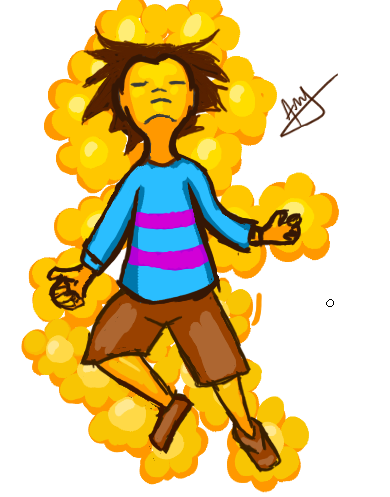
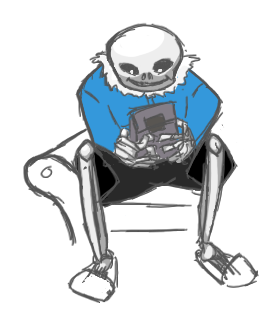
Some Art 2-16-16

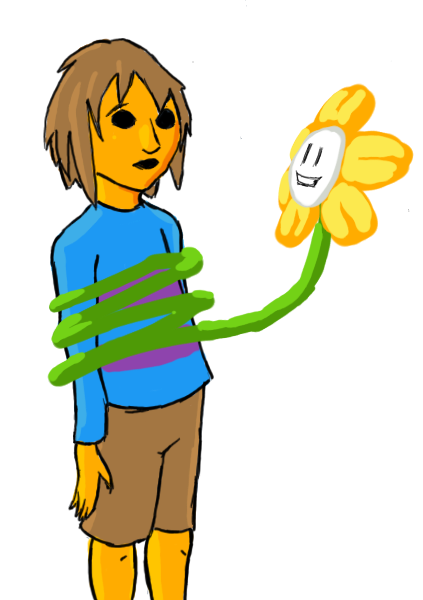
frisk2-16-16-2ibis2-16-16frisk2-16-16 sans2-16-16

someone I follow on tumblr hosted a drawpile so I drew some Undertale stuff.

Jurack Family Game Night

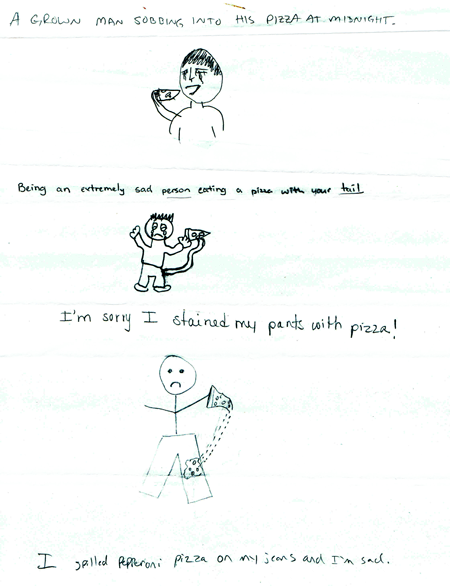
Saturday night, we had my husband’s side of the family over for our bi-monthly family game night. One of the games suggested by Kim has the lovely title of “Eat Poop You Cat” (a name no doubt inspired by results of a round of the game). The basic premise of the game is that you play telephone on a sheet of paper, and in order to garble the message, every other person draws. It starts with a sentence at the top from one person. The next person draws that sentence, and folds the paper so that only the image is visible. The next writes what they think the original message was that produced that image, they then fold the image away. The next draws that sentence, and so on. I think it works best with an odd number of people, so that when your paper gets back to you, it’s a sentence again.

Round one, we passed to the left.  The seating arrangement was me, James to the left, Dan to the left, , then Kim, Sandy, Lindy, Brett, and back to me.

amanda-left

A grown man sobbing into his pizza a midnight.
Being an extremely sad person eating a pizza with your tail.
I’m sorry I stained my pants with pizza.
I spilled pepperoni pizza on my jeans and I’m sad.

james-left

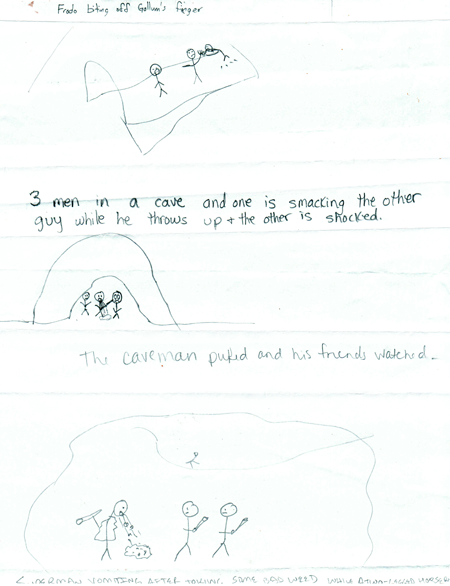
Frodo biting off Gollum’s finger.
3 men in a cave and one is smacking the other guy while he throws up + the other is shocked.
The caveman puked and his friends watched.
Superman vomiting after toking some bad weed while a two-legged horse runs away.

dan-left

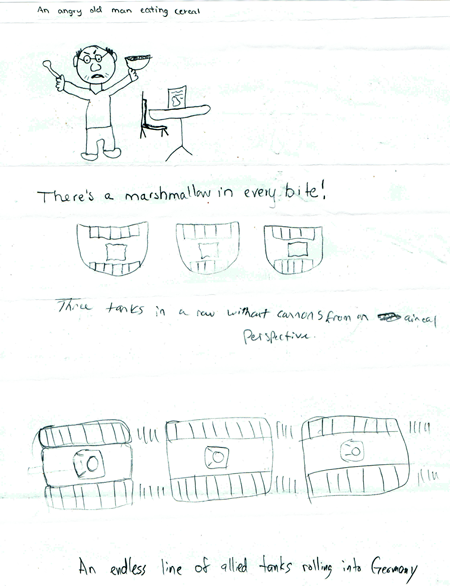
An angry old man eating cereal.
There’s a marshmallow in every bite!
Three tanks in a row without cannons from an aerial perspective.
An endless line of Allied tanks rolling into Germany.

kim-left

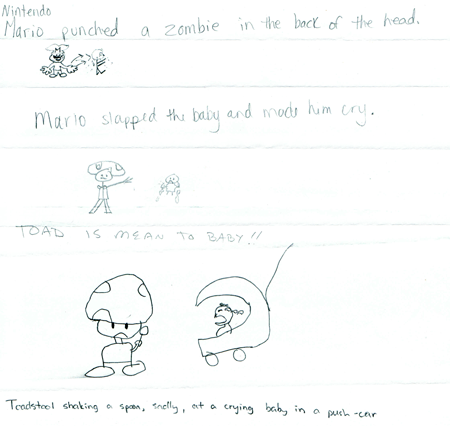
Nintendo Mario punched a zombie in the back of the head.
Mario slapped the baby and made him cry.
TOAD IS MEAN TO BABY!!
Toadstool shaking a spoon, sadly, at a crying baby in a push-car.

sandy-left

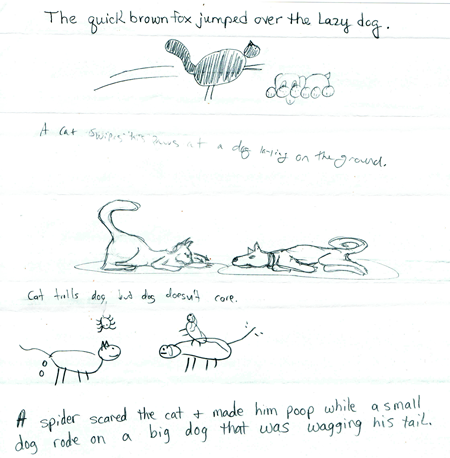
The quick brown fox jumped over the lazy dog.
A cat swipes his paws at a dog laying on the ground.
Cat trolls dog and dog doesn’t care.
A spider scared the cat + made him poop while a small dog rode on a big dog that was wagging his tail.

lindy-left

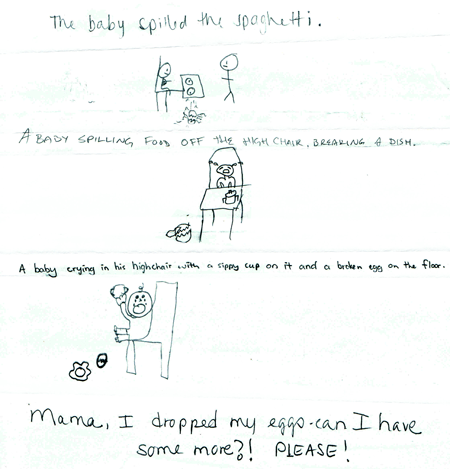
The baby spilled the spaghetti.
A baby spilling food off the high chair, breaking a dish.
A baby crying in his highchair with a sippy cup on it and a broken egg on the floor.
Mama, I dropped my eggs—can I have some more?! PLEASE!

brett-left

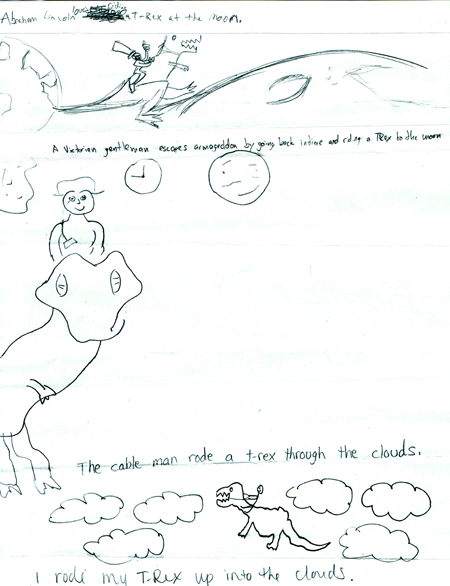
Abraham Lincoln loves riding a T-Rex at the moon.
A Victorian gentleman escapes Armageddon by going back in time and riding a a T-Rex to the moon.
The cable man rode a T-Rex through the clouds.
I rode my T-Rex up into the clouds.

Round two, we passed to the right.  The seating arrangement was me, Brett, Lindy, Sandy, Kim, Dan, and James.

amanda-right

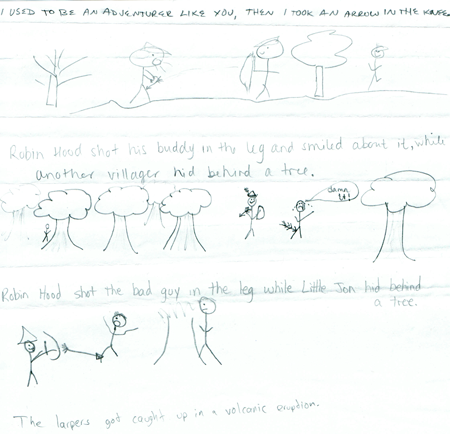
I used to be an adventurer like you, then I took an arrow in the knee.
Robin Hood shot his buddy in the leg and smiled about it, while another villager hid behind a tree.
Robin Hood shot the bad guy in the leg while Little Jon hid behind a tree.
The larpers got caught up in a volcanic eruption.

brett-right

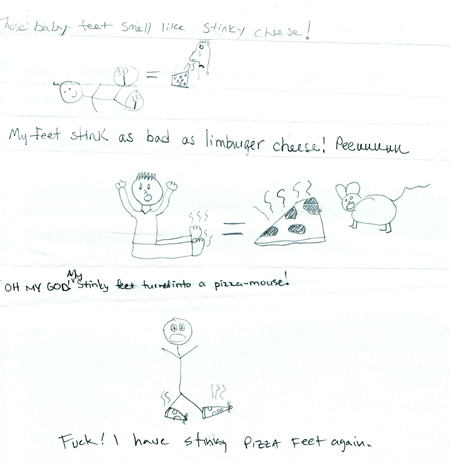
The baby feet smell like stinky cheese!
My feet stink as bad as Limburger cheese! Peeuuuuu
OH MY GOD! My stinky feet turned into a pizza-mouse!
Fuck! I have stinky pizza feet again.

lindy-right

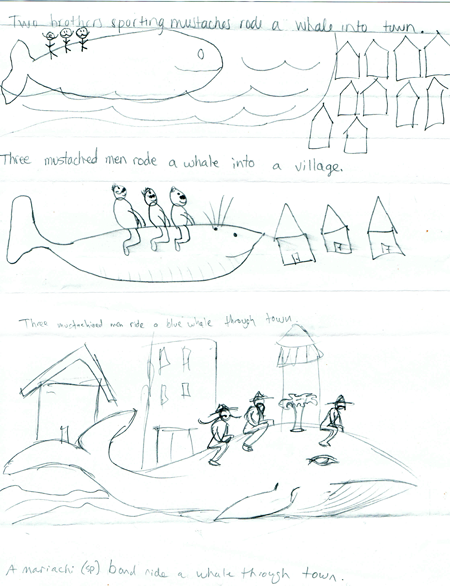
Two brothers sporting mustaches rode a whale into town.
Three mustached men rode a whale into a village.
Three mustachioed men ride a blue whale through town.
A mariachi band ride a whale through town.

sandy-right

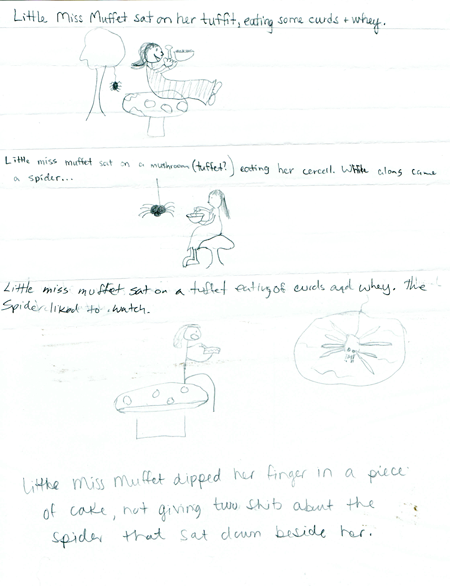
Little Miss Muffet sat on her tuffit, eating some curds + whey.
Little Miss Muffet sat on a mushroom (tuffet?) eating her cereal. While along came a spider…
Little Miss Muffet sat on a tuffet eating of curds and whey. The spider like to watch.
Little Miss Muffet dipper her finger in a piece of cake, not giving two shits about the spider that sat down beside her.

kim-right

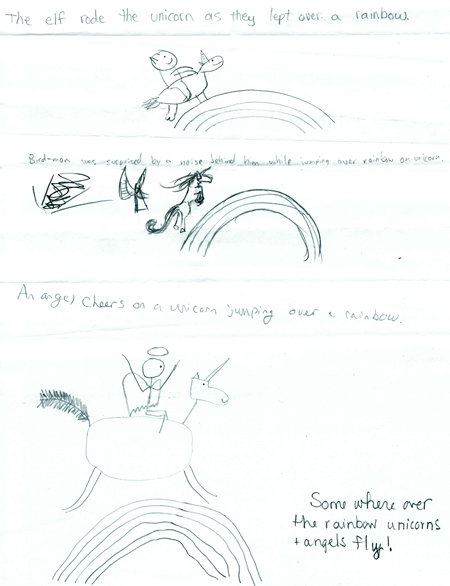
The elf rode the unicorn as they leapt over a rainbow.
Bird-man was surprised by a noise behind him while jumping over rainbow on unicorn.
An angel cheers on a unicorn jumping over a rainbow.
Somewhere over the rainbow unicorns + angels fly.

dan-right

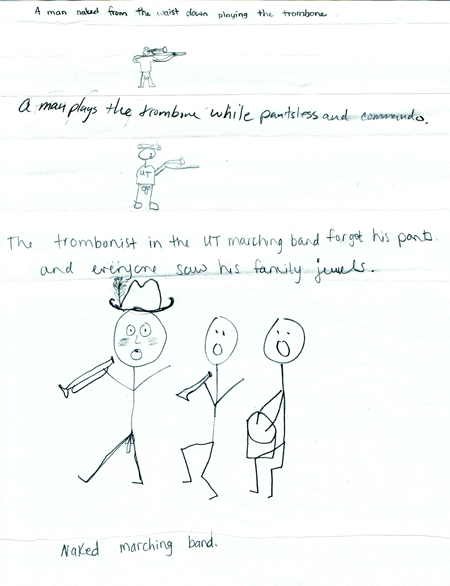
A man naked from the waist down playing the trombone
A man plays the trombone while pants-less and commando.
The trombonist in the UT marching band forgot his pants and everyone saw his family jewels.
Naked marching band.

james-right

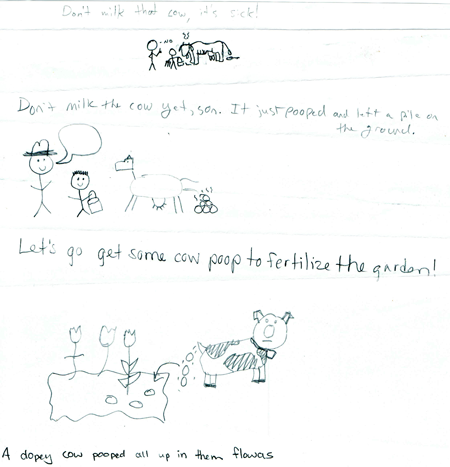
Don’t milk that cow, it’s sick!
Don’t milk the cow yet, son. It just pooped and left a pile on the ground.
Let’s go get some cow poop to fertilize the garden!
A dopey cow pooped all up them flowas.


I ended up sleeping until after everyone had left … then going back to sleep again until about 5 pm. I guess I wasn’t feeling well.

Dental Issues

Back in January, at my 6-month dental cleaning, the x-rays showed I had a cavity. My first one ever. I went along with the suggestion to get it drilled and filled right away, and within two weeks I had some white resin where there had been solid tooth before. Almost immediately, I had cold sensitivity on that tooth. I figured this was part of the healing process – and the internet confirmed it – so I waited.

Two weeks later, it was still there, but not getting any worse. I saw the dentist and they took new x-rays. It showed that the filling was close to the nerve, but it should heal up soon. The dentist said it might take longer than expected because the drilling had gotten so close to the nerve. So I waited.

Last week, I had my next 6-month cleaning. I said that the temperature sensitivity is still there; hot or cold. It’s not debilitating, but extremely annoying. I asked what my options are. I could get a root canal, which would leave much of the original tooth but remove the nerve. Or I could get the tooth extracted, which would obviously leave a gap.

I went with the extraction. The tooth causing problems was my back left molar. It was at an angle in the first place, so it was barely used. I didn’t care about retaining any of it. The dentist didn’t pressure me into the root canal, and I set up my appointment with their dentist that does extractions.

The next week, she looks at the x-rays and asks if I’m sure I want to get the tooth extracted. It’s a perfectly healthy tooth, she says. I explain that healthy or not, there is cold sensitivity that has been annoying me for 6 months and has gotten no better or worse. It has to go. I’m not wasting my time on a root canal that might end up in an extraction later.

She numbs me up and removes the tooth. Quick, painless. I ask her for the tooth. She says she’s not allowed to give it to me, but if she set it in a cup and looked away, she wouldn’t know what happened to it.

After the extraction was paid for, I drove over to my husband’s work and we took a short walk around the towpath trail. My face was slowly losing the numbness. There was some swelling, but not any real pain.

Later, I washed off the tooth that was removed and examined it. At the edge of the filling, on the inside so that when you took and x-ray you couldn’t see it, was a cavity that was the size of the filling. The dentist had missed part of the original cavity, and it either was still there or had spread.

I’m glad I got it removed.

Spider Bites

I’ve been researching various spiders recently because I’ve been trying to find out what bit me, and I’m fairly certain that it was the brown widow. We’d seen the spider around the bathroom previously, and she kept to herself. She had that definite black widow shape, but with a big brown booty instead of being shiny black. Her web was a disorganized mess, but she was collecting carpenter ants like crazy so we let her stay.

A few days before the bites, I noticed she was gone from her usual spot behind the toilet, so I just assumed she moved somewhere else after exhausting her supply of carpenter ants. I was right, and late Wednesday/early Thursday, I found out where she’d gone. Apparently under the headboard.

The way I sleep, I put my arms under my pillow, and occasionally my hands will be in the space between the mattress and the headboard. Our mattress is about three inches or so too short for the bed frame, so we have quite a bit of space there. I’m assuming she got herself somewhere around there and was just startled by my hands.

I woke up Thursday morning around 1 to 1:30 chewing on my right ring finger. It was itchy and swollen, and in my sleep I had started trying to scratch it with my teeth. At the time I assumed it was a mosquito bite on my knuckle because I’d heard one buzzing around before I went to bed.

I stayed in bed and tried to go back to sleep, but the itchiness just continued. After a while, I could no longer feel the pillow with my ring or pinky fingers. I could only feel itchiness. I got out of bed and ran my hand under cold water for a while. I noticed that I had a few spots where my teeth had broken skin, probably from my eczema blisters that were stretched out from the swelling. I used a washcloth to scratch my finger so I wouldn’t tear the skin.

The swelling of the finger was enough to keep me from closing my hand all the way. The itchiness had died down enough that I could go back to sleep, so I did.

When I got up in the morning, the itchiness was gone, but my hand was still swollen. I got out of bed and the first thing I noticed was that my right leg did not want to work. A tendon on my right knee felt like it was swollen and would not let me bend my leg without pain. James got me some ice and did the driving for the day. My leg pain did not subside, even with pain killers. I had a strange pain in my left collar bone as well. I didn’t really think that all of these were connected because I still thought it was just a mosquito bite.

I spent the day trying to find out what could possibly cause this. The results came up as widow spider bites. There are several kinds, but people only seem to fear the black widow. The articles I found said this is because the black widow will inject much more of her weaker venom, causing more pain. The brown widow, and the other widows if they bite, will use small amounts of their stronger venom. Brown widows are an invasive species, new to the US and not common enough in Ohio to be listed as having the state as in their range. Everything I read fit, but I still had my doubts. There were bites from mites and other things that could possibly have similar effects.

That night, the swelling in my hand was down enough that I could actually tell where the bites were. One just under my ring fingernail. Another about two inches down, below the knuckle. Yet another about four inches down on my hand. And another one about six inches down that on my arm. My left hand has one bite on the index finger and one on the middle finger, below the first knuckle. Those ones didn’t seem to have any ill effects other than redness and itchiness.

I began to look at various bug bite pictures, trying to confirm what was going on. Nothing I looked at really matched until I got back to widow spiders. I don’t know why I doubted it so much, but this is really all it could have been.

Friday morning, the pain in my leg had spread a little. Rather than just being the tendon at my knee, it was now my calf muscle and a muscle in my thigh. I went to work and kept my leg propped up, but then my left shoulder started to get the same pain. At one point, I went to the rest room and found another spider bite on my right thigh. That’s what convinced me it had to have been a brown widow. My right knee having pain wasn’t something unrelated to the bites on my hand. I found a bite on my left elbow later.

I left work early and just chilled around the house. I read more on brown widows, trying to ID the spider in the bathroom from memory. I was at the point where I couldn’t tell if my memory was helping me find the spider by looking at images, or if looking at images was molding my memory of the spider. I remembered the big booty. I remembered the size. I remembered the web. That matched. But the hourglass? I don’t remember seeing that. I don’t remember seeing the designs on the abdomen. I don’t remember the stripes on the legs.

Friday night, as James and I were about to get into the car, I noticed a spider in the window of the garage. She had the booty. We looked at her, and based on what we’d both seen about brown widows, we’re certain that is what bit me EIGHT FUCKING TIMES.

Fire Luen

Luens are the physical embodiment of goleuni, and this here is a fire one. Nowadays the leuni doesn’t completely take over a being, but it’s still inside.

The First Meal

I never meant to kill my first one. It was passion first, an accident second. After that, though, all intentional.

I lived as a wanderer, always. To succeed in my detached lifestyle, I needed to acquire certain skills. I could have, like many other women in my position, fucked my way to safety every night. Don’t get me wrong, I’ve had my share of whoring, it works. But these girls who did it exclusively were being taken advantage of. I don’t like being the weaker party.

I was a robber, mostly. I’d sneak in, or I’d worm my way in through pity or smarm, whatever it took. If I got nothing more than food and supplies from the people, I was happy. I never took more than I could use or sell quickly. I wasn’t looking for riches, I just wanted to be in charge of my own life. If things got too hot to handle, I’d bolt. Someone woke up, or confronted me, I’d drop it all and cut my losses. I’d never fight; I didn’t count fighting to be part of my skillset. I was a coward, truly. A mouse stealing bread crumbs from the pantry. My skin was worth more to me than whatever I was taking.

I was at the docks one day, doing as the dock ladies do. The regulars were giving me dirty looks because I didn’t dress or call out like them. I wasn’t a professional, I didn’t care what they thought clients wanted. So I stood apart. A little out of their range. Let them snigger, let them complain. Guys who know what they want can go to them. I’ll be here for the timid ones who don’t want to want to dive into the dark alley of gaping holes.

On the outer edge is where I met her, though. My first one. She was dressed head to toe in white lace and jewels. Far overdressed for even the nearby market. She walked directly to me and said, “Come with me. You look cleaner than the rest.” She continued walking, but not back the way she came.

“I don’t do housework,” I called after her, thinking she’s making a mistake.

“I know what you do,” she said without turning.

I shrugged and followed. She did not turn to acknowledge me, but she knew I was there. She made a point to only walk where there would be enough room for me to trail behind without having to look for her.

We left the docks, and followed a well worn dirt path to the rocky shore. There, she entered a split in the rocks. I stood back. The hairs on my neck prickled in apprehension at the thought that this could be a trap.

“It’s not a trap,” she called out.

“Yeah, real comforting coming from the trapper,” I called back. She laughed.

I entered.

She wore a glowing pendant that lit the way in the narrow cave. I held her hand so I’d not get lost. It was soft, as if she’d never done anything but put cream on them all day.

I tried to remember which directions we were turning; just in case I needed to get out in a hurry. It was hard, I never even felt the walls to know if there were any breaks to get lost in. She moved like she’d memorized this path.

Soon, she reached a wooden door. She tapped it with a finger and the door opened.

I panicked. I knew I shouldn’t have followed her. Glowing gems, magic doors, she’s a witch! She’s going to cut out my eyeballs and use them in potions!

Her grip was unnaturally tight. I didn’t move an inch. “Get inside,” she said, her voice soft and strong. I stilled and obeyed; I’d certainly lost my advantage. She released my hand and I looked around, trying to study my surroundings. I needed to know a way out.

This certainly wasn’t a witch’s cave—the room was tall and white, with ornate sconces dotting the walls. One wall was entirely glass panels. I saw the sea and sunset clearly.

My panic subsided and I pieced together where I was. From the docks, I had seen a tall white mansion where they said shipmaster lived. “Are you the dock warden?” I asked.

“I am the Sea,” she replied.

“So his wife,” I said.

She smiled. “You are a clever one,” she said. She explained that her husband was out to sea often, and rarely home to please her. She couldn’t bring in lovers through the front door, so she found a cave and connected it the house.

That’s what she wanted me for. Fine, I thought, I can do that, and then rob the shit out of this place. I didn’t normally steal for wealth, but this was too good to pass up. The docks would be easy enough to get to, and then get away from.

Yet, I stayed for days. I lived like a queen with her. I was her little secret to keep from the servants, she said. I never saw any, though. She brought the food and drink. So the servants either knew enough to stay away, or there were no servants. I refused to believe that her word alone kept them from her bedroom without suspecting a guest.

There was something else keeping me there, though. I could taste it every time I kissed her; she was the Sea. Her lips tasted of the salty ocean; her touch was soft like the waves lapping the shore. Every breath I took near her felt like I was inhaling her strength. She was intoxicating.

My vision changed at each encounter and all was a dream around her. Colors left, and the void was filled by thoughts of her. Of the Sea. I saw only her power—the ocean and the stars and the sky. She controlled me with them, just as I suppose she controlled her husband. I think perhaps it was his fear of her that kept him away. If he even existed.

She washed over me constantly—I no longer had an advantage, but at this point did not care. I had only a desire of drowning in her; soft and salty and strong. It was impossible to tell if I was dead or alive; to know if I was rolling in bed sheets or in waves. I don’t even know if what we did constituted sexual pleasure anymore. She both filled me and exhausted me.

I awoke one morning to find myself hungrier for her power than ever. The world looked dark and colorless, but I could tell it was already well into the morning. I looked at her, lying next to me, and she was sleeping.

I stared at her face, and, for a moment, saw a shimmer of color. It intrigued me. I held her face, positioning it to see the shimmer again. She awoke and smiled; I suppose expecting a kiss. At the time I had no interest. Her face, her lips, were darkness. I needed that shimmer. But her lips were the way to get it. I kissed her passionately, and the shimmer moved into me. I could feel it. It washed over me, filled me with the warmth of the surface of the sea. I closed my eyes and felt it seep in.

I breathed deep, and opened my eyes.

The world was still darkness.

Her eyes were closed.

I had swallowed the Sea.

Old art

I think this is from around spring of ’08. I honestly don’t remember drawing it. I’m looking through a pile of things on my desk and this is the first thing I don’t recall drawing.


Art 9/4/2012

Here are some things I did for an art class. Criteria was 8″x8″, inspired by urban scenes, and

One simple symmetry:

One bi-axial symmetry:

One basic asymmetry:

One balanced asymmetry:

There was FAR too much run-around. Worst service experience ever with a phone repair.

When I tried to enter a service request online, I filled out all the information (contact information, serial numbers, details on issue) and received a pop-up that said I need to call the service line for the request. All the information I entered was then erased.
I called the number, and an automated message told me that the service line was closed (it was the weekend) and that I should fill out the information online. It also recommended using the live chat. I used the live chat and was given ANOTHER number to call.
I called that, and was able to recite to a person everything I should have been able to fill out online. This was a waste of both my time and the customer service representative. Reciting numbers over the phone will cause more errors in entry than letting users type in the information.
Several days after Samsung received the phone for repairs, I received an email saying “Your product has been repaired and was shipped on 06/05/2012.” I receive a second email saying that the solution is “BER.” With all acronyms, you should assume that they mean nothing outside your organization. If someone has to call and ask what something means, or even look it up online, you are wasting time.
Working under the assumption that an email saying my phone has been repaired actually means that my phone has been repaired, I did nothing and waited three days for my phone. Upon opening it, I see a red paper that says my phone could not be repaired. I then had to call Samsung service to find out why, and why “BER” is an acceptable “solution” and called a “repair”.
The first rep told me (indirectly) that BER means Beyond Economical Repair). He then told me that they could not reverse the charge and would escalate my call.
The next rep told me that he would gladly reverse the charge and that the initial rep that took the service call should have not sent me a shipping label at all, as if they are trained to refuse to repair any water damage, even out of warranty.
He then transferred me to yet another representative who was disappointed at what the second rep told me and that he should have told me that they will not reverse the charge. He did, however, reverse the charge anyway.
If all this could have been avoided, I would have had a new Samsung Galaxy Nexus phone 10 days earlier. I like Samsung products. I am very disappointed in the service.