Archive for the ‘Writing’ Category

Dream 6 Nov 2023

I felt naked in that room. No one was looking at me like I was naked, but I was certain felt like I physically had no clothes on. It was an art class, and I feared that people would take my nakedness to be an art statement; a “bold” but insignificant comment on the nature of showing art. If was the end of the semester, and everyone was meant to show their body of work. I felt like I had none.

I left. If they weren’t seeing my nudity, then no one else would. As I walked down the city street, no one noticed the flaws I saw in myself. I glanced at my reflection as I passed shop windows and saw that I was dressed. I don’t remember putting on clothes, but I was clothed all along.


I felt pressured in that room. Everyone was looking at me. The instructor said, “If you’re so fast and skilled, draw [description of two things to draw]”. I looked for paper, but none of it was large enough.
“Mr. Ross, can you give me some paper?” I continued to look for paper in my bag, around the room, something.

I looked for tools, but none were the right ones. When I would find one suitable I would start to draw, but then something would break. Or it would go missing as someone else took it.

I’d find black paper, but then be unable to find white pens or pastels. I’d find light paper, and not be able to find pencils or charcoal.

Those around me also were producing art faster, but not at the quality I would want coming from my fingers. They didn’t meet the requirements of the description, but they were happy to just do the work. They were making the art they wanted, not the art that was required.

The deadline approached and the instructor asked why I hadn’t started. “I usually work larger, sir.” He produced a sheet of paper around 8’x5′ and I started to draw. I sketched one figure, and my charcoal was gone. I looked for more but could find none.


I wanted materials. The room was full of scrap paper, cut at odd angles and of a color not suitable for art. I flipped through some stacks of rectangular sheets and found the color paper showed signs of weathering and aging. These materials haven’t even been looked at in years. Who even owned them? I didn’t think I could take any of it anyway.

I walked to the next room, and called in, “Hello?”

Someone responded, “Hello, come in, how can I help you?” I walked in and saw art hanging above the desk where the man was getting up. It was cut from different sheets of paper and displayed in deep square frames to give a three-dimensional look.

“Yes, hello, I’m just looking around and was hoping to find someone who would like to tell me about their art.”

He introduced himself and took me to the art on the wall with the door. He said he spent time living in Japan but he returned because it was too expensive and everyone was too “clean”. His art resembled manga but bore some unfinished qualities like Degas’s ballerina sketches.

“How do you reconcile that the art is unfinished?” I asked.
“The art is finished as soon as your intention is met.”

A Twitter Thread

The text of the thread.

…should Twitter explode in the blaze of ignorance reserved for a spaceX 4/20 rocket launch.

Being queer and commenting on something related to Pride draws people out of the woodwork to prop up children as a shield like they’re just another Anita Bryant. To put it simply, she “didn’t hate gays” but needed to “protect the children from the homosexual lifestyle.”

What’s there to protect from? Ah, yes, the “Gay Agenda” – the great strawman of little definition that anyone can apply whatever evils they want to in order to justify their bigotry. Ignore the people actively ruining your life, there’s a queer over yonder!

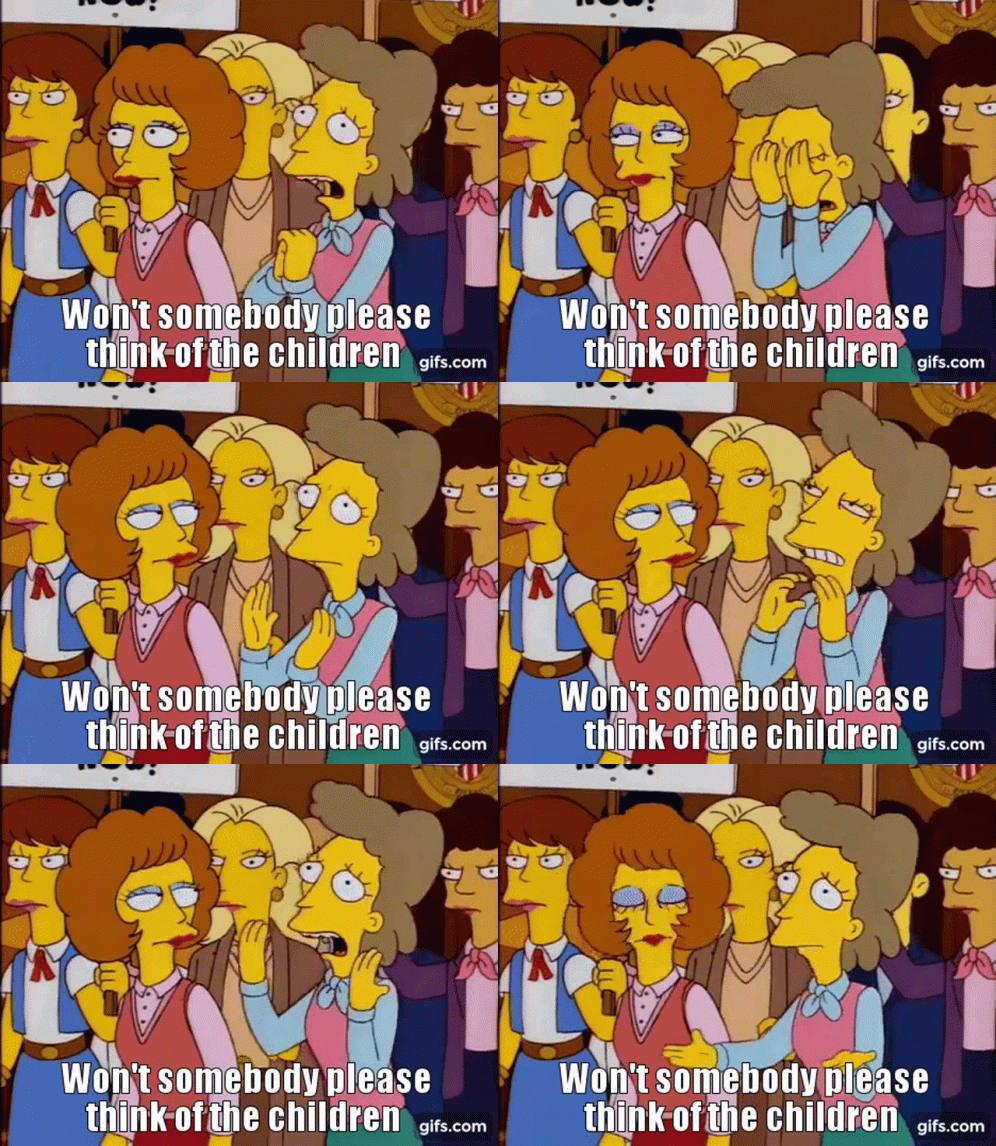
It’s extremely disheartening to find those of my generation (or any, really) are still espousing the recessive ideals of the past and trying to hide behind a “hate the sin, love the sinner” mentality or “won’t somebody please think of the children!!!” …

… like queer people don’t also have children (or gasp the queer children of non-queers) they’re trying to protect from hateful comments and actions. Call out those hateful comments, and you’re putting the “Gay Agenda” before children’s safety.

Ban this, all because I don’t agree with it, but say it’s for the children. Ban that because I think it’s icky, but say it’s protecting women. Don’t actually protect the children or women, though, because then we’d actually have to do something.

BTW the gay agenda is to exist without being made political or targets of violence, so we’re obviously failing at that every day.

People existing, who have existed for years, decades, and centuries, are “political” because it’s been brought back as another thing to point fingers at for problems. We’re easy targets when we look different from others. We look different when we stop lying about ourselves.

We look happy when we are not lying about ourselves. Yet not lying about who I am is seen as political. I’m existing in my own life with my own goals and not forcing my life on anyone, but I’m told that I’m pushing the “Agenda.” By existing.

I’m “political” for just existing because my existence means that someone out there has to not treat everyone as if everyone thinks the same. And this offends some people to the point that they want to attack the “agenda” I’m pushing by existing.

This has gone on for centuries, through all of human history, with any number of groups being othered for existing. Ignore the man picking your pocket, there are two men kissing IN PUBLIC! There are people of color who are DOCTORS! PRONOUNS! All because they want to blind.

People who can otherwise be intelligent can fall to bias. They want an explanation as to why things are not going their way and someone comes along and says, “That group over there is why.”

Why are women assaulted? They say it’s transwomen and drag shows, though there’s plenty of documentation and studies showing that it’s more likely an AFAB person will be assaulted by someone they know.

Why are children and young adults groomed? They say it’s the “gay agenda”, but it’s always lecherous people who are enabled by those around them or their status, regardless of sexual or romantic orientation.

These crazy people think that anything LGBTQIA+ is sexual because they cannot fathom that deviation from a cishet relationship is anything but sexual. Why do groomers groom? Sexual reason. Why do trans people transition? Must be sexual, too.

My transition is the opposite of sexual. I grew up being told what is masculine and what is feminine and that as AFAB I need to do the feminine things. I never fit the media representation of girl or feminine, so I assumed, for decades, that I was a failure at life.

Exposure to LGBTQIA+ media, literature, communities, etc, introduced me, at 30+ years old, to the vocabulary and understanding needed to find out how to put into thoughts, words, and actions what I truly feel like. I’m neither masc nor femme. I don’t want to be either.

Pride events bring that kind of awareness to everyone, regardless of their identity. Maybe you feel like, after seeing that there’s support out there, you identify with something other than what you’ve been told to be all your life. Maybe you don’t.

Maybe you see it all and just think, “I’m glad they’re happy, but I’m fine how I am,” and that’s great! LGBTQIA+ isn’t a faction that you have to join or fight against. It isn’t even a cohesive group that shares all ideals. There are racist gay people, and anti-trans lesbians.

There are assholes in any group. Identifying as something doesn’t mean you have to adhere to all things related to that. That’s why there’s not actually a “gay agenda” and why it’s so easy for bigots to cherry-pick what they want to attack about LGBTQIA+ people and events.

“Won’t somebody please think of the children” my stawman cries as they plead for everyone else to attack their strawman.
GIF of a scene from The Simpsons - woman pleading, "Won't somebody please think of the children?!"

Meddygon (they/them) 🏳️‍⚧️
@meddygon

This was originally written before the COVID-19/Coronavirus pandemic was full blown in the US. It feels extremely petty now and I’ve lost all steam on finishing it. Suffice it to say, I enjoyed this book and do recommend it to all to read, even if the troubling times depicted seem prescient to the current situation. What is happening now was inevitable, but unlike Station Eleven’s “Georgia Flu,” is survivable.

I first heard about Station Eleven when the author, Emily St. John Mandel, when it was announced that she would be speaking at Cleveland State University. I wasn’t able to attend, but the professor that told me about it said the book was about “a post-apocalyptic theater troupe around the Great Lakes.” I bought the book immediately, because that’s just my jam. I didn’t get a chance to read it until after graduation. I am so glad to have done so— This book isn’t about just the theater troupe. It’s about the dread of the unknown, the collapse of structure, and the rebuilding of life with the rubble that remains. I don’t think I could have appreciated the way St. John Mandel expresses anxiety that freedom brings without recently being freed from something myself. This will be the first time I’m writing about a book that I wasn’t required to read for a class. This is the first time I am writing about something I read for my own enjoyment. This the first time I get to write about my thoughts on the primary source without having to cite several scholarly sources to support my point. I don’t need a thesis. I don’t need a conclusion. All pretension and pseudo-intellectualism is gone! Meeting standards set forth by people who have no direct impact on my personal edification just to prove that I’ve memorized the prescribed literature is gone! No more bullshitting to fill a page-length on a topic I don’t care about! It’s as if all of society has collapsed and I’m now free to do whatever I want! Oh, did I just … I just made a thesis, didn’t I? I don’t care if it’s weak! I don’t care if I don’t prove it! Fuck you, I get to slack now!

Read the rest of this entry »

Oftentimes, the reader that could benefit from reading a work of literature that is intended to develop empathy for a particular plight is not likely to pick up a book that clearly advertises itself as being about that hardship. Many authors have tackled this obstacle in the past by writing speculative fiction rather than a straight narrative. The time-travel aspect of Octavia Butler’s Kindred might draw in the temporal enthusiast, but her message is still overtly about the struggles of African-Americans. Jesmyn Ward’s Sing, Unburied, Sing is a fantastic ghost story that is still straight-forward about the poverty and incarceration related suffering of African-Americans over several generations. However modern authors approach this minor subterfuge of “tricking” a reader into ingesting their message of social justice, there will still be a group of people that have no desire to pick up a book. This is where new forms of media, not just modern writing, come into play. Television and film in recent years, especially those based upon novels that have a message of social justice, reach more of an audience than just fans of the book. Video games, especially those developed by independent studios, are in a unique position to deliver the audience a perspective they would not normally have sought on their own through the allure of gameplay. One such game I will focus on is This War of Mine, published in 2014 by 11 Bit Studios. The game uses a popular game style from the time—Survival—to deliver a specific message about the lives of non-combatants in a military conflict. The tagline of the game (“In War… Not Everyone Is a Soldier”) provides the player some foreshadowing that the game is atypical.

Read the rest of this entry »

A Room of One’s Own

The below text was written for a class on British Literature, focusing on Virgina Woolf’s “A Room of One’s Own”.

Lately, I feel like I’ve been living the reality that Woolf describes regarding women and fiction – obligations from being a woman, a mom, an aunt, etc, have to be juggled with my schoolwork, my job, my social life, any an personal or free time. It’s overwhelming. And then, I have to decide, what do I prioritize? If women lack the education to write poetry, as Woolf says, should I then prioritize education? But what do I take from? Do I stop performing the  “duties” of my gender? (This is actually what I did—I consider myself non-binary in the first place, the “performance” of femininity never sat well with me, neither did masculinity. Supportive spouses are great.) Does my education suffer because of other things required of me? (If you look at my post history, you’d probably see that I don’t often get time to post, or even to think of what to post beforehand. Full time jobs are pretty much necessary for middle class parents of any gender.) Do I stop working, or take time off, in order to make time for other things? But then how would I get my “£500 a year” to afford life?  The mental labor necessary for finding time, the freedom to be able to write, and to write something that requires as intensive scrutiny as poetry, is still not afforded to women (or even men) at the present time. Prose and poetry are still something afforded to people who have an abundance of personal time, or to people who are willing to sacrifice necessities to make time.

Read the rest of this entry »

I’m stuck on one line Maggie Nelson wrote on page 37.

I cannot hold my baby at the same time as I write.”

This is something that I feared when I became pregnant, when I decided I wanted to have children. I wanted more than one before I had one; but having one has made me realize that, mentally, I cannot handle more than one. And I think it is because of this sentiment I share with Nelson.

I cannot be a proper mother while being myself.

Nelson references her quote of D. W. Winnicott that echoes how I felt with “I had nearly four decades to become myself before experimenting with my obliteration.”

I don’t think I had that. I think I was still striving to find who I was before I had my child, while I was pregnant, and even after he was born.

Women struggle with identity in ways that men will not understand. We have feminists telling us to be ourselves, to make our own decisions, to do what we will, to find our own truth of life. We have the patriarchy telling us to be good and start a family while we can, before complications arise from age, before whatever. Before we’re whole. Be a mother before you’re human.

Read the rest of this entry »

While I plan to finish the entirety of I’m With the Bears shortly, I am still on a deadline because this is for a class.

I spent yesterday at a relative’s house for a family reunion, in the 94°F (34.4C) heat (“feels like: 100°F” (37.7C) says the Weather Channel) when outside, in something significantly cooler but still warm indoors. Air conditioners that once made the interiors of houses comfortable can only manage “better than outside” in the summers now. Living in a house without central air has gotten me used to sitting in a room that runs around 80°F (26.6C) as the tiny, single-room AC unit in the window struggles to counter the increasing summer temps.

It was James’s side of the family, so the reminiscing was not for me. I hung around with those that married in and we discussed things. The conversation was usually about jobs, status of vehicles, the temperature outside. We talked about how hot it is, how it used to not be that hot, but there was no discussion deeper than that. This wasn’t the time or place for it. It was too hot.

My job as an energy engineer/analyst/manager for retail corporations fits snugly into this changing climate. My goal is to save them money by running the AC efficiently. Making stores comfortable so people buy things. On the surface we can tell people that we’re trying to be more environmentally friendly, but it’s all about money.

Read the rest of this entry »

Outside the shop, a man nervously approached the door. He would take a few determined steps forward before losing all courage, at which time he’d stop, turn, and go back the way he came. This repeated several times as Darina watched. He made a small amount of progress with each attempt, small enough that she grew impatient watching him. She stood beside her bicycle and waited. He would enter soon, she was certain of it, his time was near. She was there to guide him, but she couldn’t do it until he went inside.

Darina screwed her face in annoyance and squeezed the handlebars on her bike. As they warped in her fingers, she heard a short gasp from beside her. There, on the bus stop bench, sat a young mother and her infant. “I’m not after you,” Darina said, irritated. The woman clutched the child closer to her breast. “Nor your brat, so don’t suffocate it.”

The door to the shop across the street had bells tied to the handle that jingled as the man finally went inside. Darina quickly collected her bicycle in her hands, warping and bending the metal effortlessly out of existence. She made haste for the shop front, pausing in front of the door to make sure the man was not looking out the glass. Currently, he was engaged in looking like a nonchalant shopper, though he still showed signs of anxiety.

Darina sighed and opened the door as quietly as possible, distorting the metal of the bells enough to prevent their announcement of her entry. It should not be this way, she thought. He has the blood of a great house in him, but houses were no longer powers in this land. Here was this man, distant ancestor of a great lord that once ruled half the State with his cunning and valor, reduced to robbing a shop just to afford a place to rest.

Desperation does funny things to people’s minds. She’d seen it before, in others she was sent to guide. It’s manifested itself to her has begging, bribery, and brutality. Most men knew, however, that when a Guide came to them, it was their time, and they were to accept it.

She made her way to a corner of the shop, stooping slightly to be out of the man’s sight. A few moments later, all other patrons had left, and only Darina, the man, and the woman behind the counter remained. The woman saw her, recognized what she was, and grew visibly tense. Darina shook her head slightly, hoping to indicate to the unlucky woman that it wasn’t her time today.

The man turned toward the counter and drew a firearm in one swift motion. The clerk seemed to have taken the hint from the Guide and ducked below the counter. The potential robber leaned over the counter to point his gun at her, but the weapon was quickly swatted out of his hand by the clerk.

Darina advanced as the clerk rose from behind the counter with an aluminum bat. The man dodged her swing by hopping back, but in his haste knocked over a product display. As the clerk retreated into the office to contact the authorities, Darina positioned herself in sight of the man. He looked at her, then looked around at the floor, the ceiling, trying to spy anything that could help him. He looked toward the counter, finding that clerk had come out of the office again. She was aiming his gun at him. Their eyes locked only briefly, and the woman fired.

The man turn as the bullet impacted with his shoulder. Darina caught him before he could fall to the ground. He looked up at her, and she graced him with a smile. She hoped that it would comfort him in his final moments. His death was imminent, predicted in the tapestries of time and life to be this day, this hour, this place. She awaited his final words…

I hear you things bleed black,” he said as he smiled back at Darina. Her smile quickly faded, however, as she felt something sharp punch into her belly. Again, and again, she felt it. The pain was more than she’d ever felt before; it distracted her so much she barely heard the clerk fire the gun several times more. Eventually the man’s efforts to slay death ended as he succumbed to his new wounds.

The man and Darina fell to the floor in each other’s arms at that point, shock still dominating her facial features. The clerk grabbed the man by the back of the shirt and dragged his body aside. “Who guides you?” the woman asked, her voice faltering in confusion as she attempted to staunch the blood flow with her hands. “Who guides you, who guides you?”

You,” Darina managed to say in a labored breath, “you . . . are Mi—“

Yeah, I’m Mirna,” the clerk cut her off, hoping to save the dying Guide the effort of speaking. She removed the sweatshirt she was wearing at that time and placed it over Darina’s midsection, pressing it firmly. “You do bleed black,” she said as the blood quickly soaked through, and then, more to herself than to the dying, “Who’s going to take care of you?”

Darina struggled to speak, but managed in halting breaths, “I will never die.” She placed her hands on Mirna’s wrists and pushed feebly upon them. Mirna took the hint and released the pressure upon the wound. Darina took the blood-soak clothing off her stomach and tossed it aside before passing out completely upon the floor.

#

When the police and paramedics arrived, none knew what to do with Darina. Mirna listened as they discussed, but was involved in her own conversation with the police.

While explaining what happened, she caught some snippets. An officer insisted that the Guide be patched up. A medic said that they couldn’t treat the guide, citing her complete lack of internal organs as proof that nothing could be done. Another officer said that she should just be carted to the morgue along with the failed robber. The medic responded that he couldn’t do that because the “thing” wasn’t dead.

Calling Darina a “thing” didn’t sit well with Mirna. She called out to the group, “That ‘thing’ saved my life!”

It also caused you to take another man’s life,” responded the officer interviewing her.

Mirna’s face went blank. She hadn’t yet thought of that. She was the one that shot the man to death. It was so easy to forget that the Guides did not kill, they were merely there when a killing occurred. But this time, this time the Guide was hurt. This time, Death was dying. Mirna had shot the man once in self defense. She killed him because he hurt Darina.

#

The authorities had finally decided that Darina should go to the hospital; they didn’t know much about Guides, but they knew that there were other Guides wherever death occurred. They were sure that one of them would know what to do with this one.

Mirna watched and waited as the Guide of the hospital came in to evaluate Darina. He stared at the open wound that was no longer bleeding like a tipped inkwell.

In a motion that made Mirna feel ill, he placed a finger inside the inert patient’s cavity, then to his mouth. He tasted it, and looked thoughtful about it. Mirna squirmed, and he smiled. “She should return to Yntraw,” he said.

I can’t take her,” Mirna responded nervously. She lifted her hands so that the Guide could see they were bound to each other and then to her ankles. She was a murderer, but the peacekeepers felt she would not cause harm locked in a room with Death.

He smiled a mischievous grin that made Mirna even more squeamish. “She needs death to survive,” he said as he leaned toward her.

Mirna recoiled as if he’d advanced on her. His presence was overwhelming. She suddenly realized how horrible a plea it was when she asked to be alone in the room. She was now surrounded by two agents of death, one needing her to die to save herself. A darkness washed over her vision and she cowered.

The man (if he could be called such a thing) laughed. “I am Aras,” he said, “And I am not here to guide you.”

Mirna remained in a tight, fetal ball until she heard his footsteps retreat and the door shut. She crawled to the bed on which Darina was laid out. The hospital did not want to waste quality equipment on someone who would not benefit from their services, and so had given her a broken bed and some stained sheets. “Why is this happening?” Mirna asked aloud, expecting and receiving no response. She rose to her knees next to the bed and placed and elbow as best she could upon the mattress.

She looked up and found herself staring directly into the gaping wound. Before she could verbally express her disgust, she involuntarily touched the blood pooled in Darina’s open gut. It coated her finger like tar, far thicker than what had covered her hands and arms back at the shop.

Out of some warped desire to know what Aras had found so interesting about the flavor of this pitch-black liquid, she too placed her finger into her mouth. Her world rolled around her, her vision twisted and blurred. Everything in her body told her that she needed to vomit and to do it quickly. She was unsure if she ever did, because she soon blacked out.

#

Mirna awoke to find herself in a bed next to Darina, with Aras sitting between them. “Oh good, you are awake,” Aras said as he heard Mirna shift under her bedsheets while she looked around. “Your friend was awake.” Mirna looked to the other bed and saw part of it was melted and twisted near Darina’s hands. “She sleeps now, but soon we will take her to Yntraw.”

We?” Mirna coughed. She could taste the stagnant stomach acid in her mouth. “I’m pretty certain I can’t go anywhere,” she said and lifted her hands. The cuffs and chains clanked.

Darina will help,” Aras replied, pointing to a warped portion of the bed. “It will be wonderful. You will be a ravishing fugitive, I will be mysterious protector, and she will be our beautiful, haunted princess. It will be like a grand adventure that you only hear about in stories.” He smiled and turned to Darina. He placed a hand on her belly, caressing it.

Mirna shuddered. Everything about Aras made her uneasy. He was tall and unbearably thin. His skin was as pale as bleached paper. She could forgive appearances, though, if he’d just stop behaving in an inhuman way. And now he was telling her that he’d be kidnapping her away to the homeland of the Guides. His plan sounded terribly wrong in her head, but she had to consider her alternative: rotting a jail cell for however long they put murderers away for.

That’s pure nonsense,” she said, “and I’m certain you already know I can’t refuse.”

Of course.”

How are you getting me out of here?”

In a word, magic.”

(I’m done for tonight.)

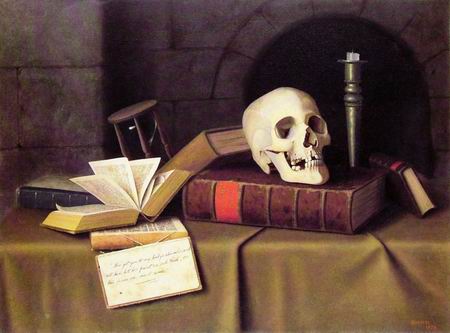
William M. Harnett, Memento Mori—"To This Favour"

Memento Mori, “To This Favour,” 1879

Oil on canvas

William Michael Harnett
(American, born Ireland, 1848-1892)

The Latin Term memento mori describes a traditional subject in art that addresses mortality. In Harnett’s example, the extinguished candle, spent hourglass, and skull symbolize death. A quote from William Shakespeare’s Hamlet, inscribed on the inside cover of a tattered book, reinforces the theme. It comes from the play’s famed graveyard scene, where Hamlet discovers a skull and grimly ponders his beloved Ophelia, ironically unaware that she is already dead. The “paint” in the quote not only refers to Ophelia’s make-up, but also wittily evokes the artifice of Harnett’s picture.

Mr. and Mrs. William H Marlatt Fund 1965.235

(The Cleveland Museum of Art)

While most still life paintings offer no narrative in their imagery, this does not mean there is no meaning to the piece. The meaning of this work by William Michael Harnett is offered directly in the title: Memento Mori, “To This Favour”. Even viewers not familiar with the Latin phrase memento mori can suss its meaning when viewing Harnett’s painting. An empty hourglass, a burned candled, and a skull are all icons of passing on, giving rise to feelings of one’s own mortality. As the phrase translated states, “Remember, you must die,” and so the viewer does. However, the meaning of this memento mori goes beyond that simple phrase.

“To This Favour” is a predominately dark piece, both visually and thematically, drawing the viewers attention to specific iconography with the touches of whiteness. The largest body of light color is the pages of the open books on the left. Harnett is known for his style of trompe l’oeil; in this instance he tricking the viewer’s eye into thinking one of the open books is motion. The upper of the two open books has three pages splayed in a position that would be impossible to capture in a still life painting if it were actually in motion. Each of these three pages curves in the exact manner one would expect it to do if it were falling under its own weight after being turned and left to fall to the opposite side of the book. Such is the trick, the tromp l’oeil, that the eye thinks the image so real that the page would fall at any moment. The book itself shows no meaning of death. The viewer cannot see the title nor read the text within it. Rather than be a symbol of the permanency of dying, the book, being half-open and in motion, may be a symbol of life: a life life half-over and passing quickly to the end.

The lower book is open as well, though its cover is torn from the binding. The aged, damaged book cover hangs over the edge of the table by a thread as if it, soon shall die. The inside cover is the closest object in the painting to the viewer, demanding one’s attention to the quote it bears. From Shakespeare’s Hamlet on the subject of death, the inscription reads: “Now get you to my lady’s chamber, and tell her, let her paint an inch thick, to this favour she must come.” In the play, the paint is Ophelia’s make-up; in this piece, the paint is the oils used by Harnett. Both paints are applied with thoughts death, which may have prompted the artist to use this particular quote. As one may know, Ophelia is already dead at the time the line is spoken by Hamlet, further compounding on the theme of death in the painting.

The next largest collection of whiteness is the skull, quintessentially the most recognizable symbol of death. The skull, like the book, is aged and damaged. It lacks several teeth and is a dirty, off-white color. Unlike the book, the skull faces to the side. The skull looks to the right of the viewer, whereas the book’s cover opens to the viewer directly. This positioning by Harnett aids in drawing the eye to the quoted text for which the painting is titled. The skull rests atop yet another book, this one much thicker and less damaged than the first two. The spine shows it to be a collection of Shakespeare’s Tragedies, which, like the thoughts this painting is meant to provoke, is full of death, loss, and mourning.

Another obvious symbol of passing used by Harnett is the extinguished candle. Light entering the scene from the left side of the painting creates a reflection on the candlestick. A broken line of white draws the viewer beyond the darkness of the whole piece to the candle. On the table, it sits behind the skull-topped book. Behind the candlestick and skull is naught but a darkened archway; a light-less passage through which the used-up candle cannot guide the viewer. Even the off-painting light source cannot guide the viewer’s eyes to what lies within that hall. It creates a sense of anxiety and anticipation at the thought of the great beyond. One cannot see what is through the passage, just as one cannot know what is seen after death.

Behind the open books sits an empty hourglass, presumably the sand has run out to the bottom though it is not seen in the painting. It is yet another iconic reminder of one’s own mortality and the passage of time. It is tilted in a slightly unsettling way and is perhaps propped up by one of the other books behind the open pair. Like the open book before it, the hourglass appears to be at the cusp of motion. It appears ready to fall, or even already falling, in its tipped position. The only portion of the glass seen is that which reflects the light from the left. The lighting effect may be Harnett’s real reason for presenting the hourglass at an angle. The glass is so clean that the viewer can see to the stone wall beyond and, had the hourglass not been positioned as it is, the reflected light may have been too much or too little. Too little, and the hourglass would go unnoticed. Too much and it would detract from the whiteness of the book cover and detract from the intended focus.

The books surrounding the hourglass have no visible titles, though they appear to be at different stages of aging. One book, positioned at an angle on the left side of the Shakespeare tome, has a few pages that seem to be shifted and poking out of the rest. This can be read as a well-used book that is possibly near “death,” though not as near as the book with quote upon it is. A book lays flat to the left of the hourglass and the open books. It appears to be smooth and not at all damaged, though perhaps a bit dusty. The sixth and final book is perhaps in the same stage of life: its pages are neat and straight, but are yellowed from age.

The table upon which this memento mori still life is placed is a drab, olive-brown. It does not shine like the silk painted by other artists using oils, but it is as smooth. It seems to be very plain, which could be indicative of it being over-used and near its end along with the books and candle. The lack of luster in the cloth, as well as the rest of the objects, shows death to be very mundane and common. This fits with the sense of tragedy in Hamlet as no death in the play is glorious, no one died a martyr, and celebrated at another’s death.

Still life paintings are oft devoid of deep meaning. However, William M. Harnett’s Memento Mori, “To This Favor” bears a rich subtext of the commonality of aging and loss in addition to it’s obvious subject of death. Each object is positioned to relate to the other as aging, death, and anxiety all relate to each other. Harnett’s work reminds one of one’s own mortality as intended, but also reminds us that those we love will pass, too.

Worst. Essay. Ever.

Las Meninas, Diego Velasquez, 1656

Las Meninas, Diego Velasquez, 1656

Before reading this I feel it is important to understand the context under which it was written. This is an Art History class for non-art majors, focusing on the renaissance through cubism. This is for exam two. The class is two hours long, and the first portion of the test is fill-in-the-blank coupled with viewing of projected slides of various paintings the class had learned about. The essay portion allows the student to choose one of three topics and use whatever time is left of the two hours to write the essay. The test started at 6:15 PM and I left the classroom at 6:48 PM. I’m not certain how much of that time I was actually writing the essay, as I was writing between slides as well.

The prompt I chose for the essay was: “Valesquez’s Las Meninas 1656. Describe the form and content of the painting. What are the two subject matter. Describe the way the artist includes the viewer and how he leaves the meaning uncertain.”

And so, here is what I refereed to as my “worst essay ever” (though I suppose if I wrote “dog poop” a few times and turned that in, it’d be worse):

Las Meninas is a portrait of the princess of Spain, while implying to the viewer that they are the subject. As the handmaidens attend to the princess, she, the attending dwarves, and the artist acknowledge the viewer’s position is occupied. The mirror in the background shows that the king and queen are looking on, possibly the subjects of the painting-within-the-painting. Velasquez effectively places the viewer in the king and queen’s shoes. It is only momentarily, however, as a courtier in the back of the studio opens a door to prepare the way for the royal visitors.

All the above is subject to speculation, however, as the man in the back can be coming or going. As well, it is not clearly indicated if the royal pair are visiting or sitting for a portrait. The king’s dog also in the painting, but what he’s doing there (other than being prodded by a dwarf’s foot) is not certain. I personally read this painting as the king and queen having their portrait done and the princess is waiting (possibly impatiently as implied by the maidens fussing over her) for her turn to be included in the portrait.

There are two light sources in the painting. From the right, natural light enters and brightens the princess showing she is the true focus of the painting. Rather than being a simple group portrait, Velasquez included implied movement, making the painting a snapshot in time. The second light source is in the back, where a man looks on, interrupting the scene just as the light interrupts the dark background.

I, like many others out there, avidly review my credit card statements. I view the card’s activity online before statements to make sure there aren’t any unauthorized purchases on there. I don’t think I’ve actually found any in the eight years I’ve had this card. When statements come around, I like to know exactly what finance charges are applied. This month, for the first time, I saw “FOREIGN TRANSACTION FEE*FINANCE.” Having never made a foreign transaction on this card, I immediately questioned it through their secure messaging system.

Subject: FOREIGN TRANSACTION FEE*FINANCE
Date/Time: 05/13/09 07:22:15 PM
You wrote:
I would like more detail on the following as I do not recall making any foreign purchases:
05/12/2009 FOREIGN TRANSACTION FEE*FINANCE CHARGE $1.92 Transaction Type: 3 Post Date: 05/12/2009 Reference Number: 00000000 Charge To: Standard Purch

Read the rest of this entry »

HQotD 12/12/2003

Schroe 12/12/2003 8:06:46

So, how’s it going?


TheNintenGenius 12/13/2003 2:27:45

Death. All is death. Death death death. Dying death dead death. Death die. Deat-

Oh fine, things are going OK. Nothing ever happens here, let’s face it. It’s boring. You’d expect at least a triple homicide or two to liven things up, but NOOOO, things are progressing normally. I hate it when business is slow.

I should go to Iraq, man. They need angels of darkness like myself over there right now, I know it! Then I can reap some souls and get things over with before Christmas.


Canjo Rarebear 12/12/2003 22:11:47

It’s going terribly. On the bus ride on the way home today they were playing “Feliz Navidad” on the radio and, as ALWAYS when I hear it, which is EVERY DAY, it got stuck in my head.

I hereby propose a measure whereby any radio stations found to be playing that song are to be foreclosed upon, and all employees thereof executed by guillotine.


HappyBob 12/13/2003 5:29:10

Oh, it’s easy for YOU to say, but somewhere out there, while you’re eating your caviar, driving your fast cars and posting on your internet forums, an African child is doing something.

Think about it.


Stychard 12/13/2003 13:51:37

About as smoothly as Blizzard’s attempts to get hacking off of B.net. Yeah, THAT smoothly.


Canard 12/13/2003 17:04:55

It was all going well until another car cut Sally off, causing her to swerve off the road and into a tree. She woke up in the hospital several months later. The hospital was dark, and she couldn’t feel the presence of anyone in any other rooms. “Hello?” she muttered under her breath.

At that moment there was a sudden, startling rumbling noise coming from outside. A tree branch thrust itself through the window and grabbed Sally by the neck.

“Why did you run into me?” the tree said in a deep voice.

“It wasn’t my fault! Someone cut me off! Let me go!”

“Oh, really? Guess I shouldn’t have destroyed all mankind, then. I only kept you in here so I could have some answers, and then kill you.”

Yup, all the world was going juuust fine.

HQotD 11 Dec 2003

Schroe
Thu, 11 Dec 2003 07:45:12 GMT

I made a huge mistake. I thought about upgrading from ibv3.0.2 to ibv3.1.2. As you can see, the Cork Board is currently on 3.1.2, but at no small price. While upgrading the Cork Board, the old databases became corrupt, and I had no working ones elsewhere. All the posts were lost. All 14K+ of them.

So it’s gone. The backups that I did have were no good. It’s all gone.

Not like there was much there, but I’m sorry. I’m sorry I lost what people had given.

The Cork Board celebrated it’s fifth year this year. It went by with no one noticing, and with me not saying a word.

I guess a new start is something I need, though. Now that it’s completely clear of any bugs, any missed images, I should be fine. I should be able to keep this up again.

If I don’t go crazy from everything else first.

So, the first question, which I do not expect to be answered about the board, as it is a Happy Question and must be answered happily (or at least in an entertaining manner) and I will not be happy with compliments or criticism right now – where was …. right, the Q.

How does it look?


Jorenko
Thu, 11 Dec 2003 08:22:35 GMT

    \   |   |  |   \  |   \     \
\____|  \___/  |    \ |    \    |

“Well it’s . . . it’s kind of hard to tell from here.”
“Is it?” squints “Yeah, I suppose you’re right. Let’s move in closer.”
“No, we need to be farther away.”
“Further? Are you mad?”
“No, I’ve just got a hunch.”
“Fine, let’s just go.”

“Far enough now?”
“I think so.” turns around “Yeah, that’s good.”

SORRY FOR THE INCONVENIENCE


2049something2
Thu, 11 Dec 2003 11:05:28 GMT

I think I can get used to that…

*dies*


Stychard
Thu, 11 Dec 2003 14:20:22 GMT

My eyes!!!! MY EYES!!!!11!11!11!!1


TheNintenGenius
Thu, 11 Dec 2003 14:51:50 GMT

“The appearance of the male of the species often differs quite substantially from the female of the species. The growth of hair around the lips and on the chin signifies some o-“

“Oh knock it off! I meant the clothes. How do THEY look?”

“Human beings are known for creating a wide variety of garments with which to protect their bodies from the elements. Over time, these garments have changed substantially as technology has impro-“

“KNOCK IT OFF. Have you been watching old BBC documentaries or something? Speak normally, would you?”

“The human is, of course, a very vocal beast. It is unknown as to when humans created language, but it has led many scientists to believe that it is this formation of language that tied into the humans’ development of the self. Thi-“

“You’re fucking hopeless.”


Canjo Rarebear
Thu, 11 Dec 2003 23:36:22 GMT

I have completely arbitrarily decided to tack my last name onto the user name.

Okay. None of the recent stories I’ve produced for Creative Writing have been funny stories. Not that I think they have to be funny to post here. But I haven’t felt that magical feeling…oh, screw magical feelings. It’s a happy story.

Opening Word….

Okay this is taking an aeon….

I wrote this story after producing a massive research report about Yugoslavia under Communism. It was floating around in my head. Also, I was cursed by Yugoslavia for that week, and this was an attempt to exorcise the curse.

The Story of Marija, Obra, and Aleksandar

In 1942 the Communist Party of Yugoslavia began publication of the periodical “Slobodni dom,” or “Free Home,” in Croatia to encourage national unity in Yugoslavia and support for the Popular Front. The periodical was full of parables, axioms, stories, etc. to serve its purpose. This is one of those stories.

Marija Hrvatsko is a Croat. What do you think about her now? I’m sure you think she’s going to be the hero of this story. But maybe she won’t be. Marija lives in the countryside with her family; she is the grandmother of eighteen children, and she lives with them on their family farm up in Croatia. But you knew that already, right? But are you sure? What would you have thought if I told you she lived in Bosnia, Slovenia, Serbia, or Hercegovina? How about Vojvodina or Kosovo? Think about it. Now, Marija loves talking to her grandchildren and telling them all sorts of things, even the sons and daughters of not just her firstborn but her second-born, third-born, fourth-born, and fifth-born. She teaches them all, unlike the custom, because she knows the best way to teach them for them to grow up as good, peaceful, happy people. This is the story of how she found out.

Marija is certainly hard worker in her old age, but she didn’t used to be. She used to complain and fiddle with her black dress and have her brothers do all the work, and later when she moved away from her brothers, she made her sons and daughters to work extra since she didn’t, and even more after her husband died. Since the Hrvatsko family was lucky to have extra-fertile soil between mountain peaks, they never had problems selling enough even though Marija was lazy. On the contrary, they sold more turnips than even the Markovic family, which owned such a huge estate that every other estate in the village of Bag bordered on one of its sides.

Now, Marija’s first son was named Pavle, her second was named Aleksa, and her third was named Petar. She also had two daughters, Pavla and Bagska. Every month for years right after her husband died she would go down to market with some money she found around the house and buy turnip seeds and make all of them sow them and harvest them, planting a new set of seeds each month on each field so that a new harvest came each month. I bet you think Marija’s clever like that because she’s a Croat, right? Well, one of her best friends is a Slovene, and she got the idea from her. That Slovene is named Obra, and she doesn’t look dirty at all. In fact, she washes her face every day and even brushes her teeth—more than Marija can claim to do, I’m afraid. Obra hasn’t got any children because she thinks she’s more useful without having a bunch of little mouths to feed, even though you probably thought she had about seven million children because that’s what you thought all Slovenes were like. Now you know otherwise, see?

Obra is also a member of the Communist Party, a leading member of a democratic coalition seeking the national liberation and unification of all Yugoslavia. She’s taken that idea to heart, and she’s had that idea since she was very small. So she was a communist when she first met Marija in Bag. Even then she was so committed to the ideals of the Party that she didn’t even think of herself as a Slovene, but [imparsable] as a Yugoslav, because the national differences in were and still are only backwards remnants of feudalism. Obviously, she knew that, and she tried to tell everyone she knew, as she still does today. That’s how Marija and Obra met, in fact.

“Hello!” said Marija one day, before the birth of her last son Petar. “I haven’t seen you around! Who are you?” she asked Obra.

Said Obra: “Obra, and you?”

“Marija,” replied Marija, noticing Obra’s strong Slovene accent. Marija was confused then, because Obra didn’t look like a Slovene at all, nor did she smell like garlic like all Slovenes do. Of course, we know all Slovenes don’t smell like garlic, but Marija thought that because she was ignorant. Did you think that? I’m sure you didn’t. We’ve come so far from the days when this story I’m telling happened; it was almost 20 years ago! So Marija asked, “Are you from around here?”

“Why does it matter?” asked Obra, “I’m a South Slav, and so are you. There are only regional differences between us, and we all have the same historical roots. Why does it matter, I ask again?”

Marija was quite stumped. She had never seen this attitude before, and it confused her. But Obra and Marija kept on talking, and they became friends. Eventually Obra told Marija about how to use her fields to grow as many turnips as possible, and for a while Obra even worked on the fields with Marija’s offspring.

Sometimes Obra talked to Marija’s family over dinner about her Communist ideas, and Obra found a lot of time to play with Petar when he was only as tall as a milk bottle. But Obra found that Marija’s family wasn’t very strong.

“Marija, why is it that Pavle and Aleksa never talk, and rather stand with their backs to each other and their arms crossed? They are brothers, can’t you see? Shouldn’t they work in harmony, and couldn’t they triple the turnip harvest if they worked together?”

“I don’t know!” said Marija, “it’s just that Pavle and Aleksa slept on different beds, I guess. I know the other kids don’t do that, because not doing it is a Croat custom of ours. Are you saying I should be more traditional?”

“By no means, my sister!” declared Obra, “you should not just follow tradition, but you should think about what you do. In an address at the second party congress that I attended, Comrade Rankovic told us about that in his stirring address in Novi Sad at the Second Party Congress. We should think about what we do and decide for the best ourselves. That’s why I joined the Communists. Don’t you think that’s the best choice of affiliation? But to the matter at hand: couldn’t you see raising them apart would cause differences? Of course, they are small differences, and only really in Pavle and Aleksa’s minds. And their continued conflict is only harmful.”

For a year Obra even lived in Marija’s house. It was around then that the Markovic family left their mansions and vast wheat fields and the Rankovic family moved in.

Aleksandar Rankovic was a Serb. A Serb, of all people! Now what do you think of him? In that huge estate! Do you think he’s going to try to take over because he’s a Serb? What do you think?

Aleksandar Rankovic had seven children—so much for the idea that Serbs only have two children and eat the rest! What a ridiculous notion that was in the first place. I certainly hope no one today still believes that. Aleksandar was also very kind, and he gave a large portion of his wheat harvest to all his neighbors. Marija didn’t want to accept his wheat, because she thought he had poisoned it.

“Marija, I offer you this wheat of my harvest as a token of friendship; why do you deny it?” asked Aleksandar at Marija’s doorstep one morning. Marija was afraid that Aleksandar had poisoned the wheat out of hate for the Croats, since he was a Serb. But we know Marija was wrong.

“Shut up!” said she, quite rudely I might add, and slammed the door in his face. The next day, he was there again, and the next day, and the next day. Marija started becoming jealous of his large estate, and started forcing her children to work even harder in the turnip fields, until they hardly got any sleep at night. Now then Obra was living with Marija, and she stopped her one day and asked: “Marija, why are you doing this? Comrade Rankovic is a kind man. Is it because he’s a Serb? I thought you were beyond that, Marija. I really did. Are you really so backwards? Don’t you realize that that’s just a mediaeval token left over? Aren’t we out of the feudal times? Marija, what have I taught you?”

Marija was quite ashamed, and she went to the Rankovics’ house the very next day. She stood at the door and knocked on the four corners of the door as the Croat custom was and still is, and Aleksandar answered.

“Oh, hello, Marija! How wonderful to see you,” said he. He looked as if he had just finished shaving, since he had some cuts on his chin, and his blood was red, not green as Marija thought Serb blood was. (You didn’t think that, right?)

“Mr. Rankovic,” began Marija, faltering, worried.

“Don’t be afraid, madam,” said Aleksandar, “I understand your national fear of me, and I pride you in overcoming it. You see, I am a member of the Communist Party of Yugoslavia, and I believe not in nationalities but in one Yugoslav nation, maybe with a few differences between some places. Please do not be afraid. Would you like some of my wheat? I am very generous with it.”

But by now Marija had begun crying. Aleksandar took him into his house, which, although large on the outside, was small and homely on the inside. He sat her down in a wooden chair and patted down the black shawl over her head.

“Now, Marija,” he said, “Don’t you think if you had listened to Obra instead of your silly fears you wouldn’t have this situation? And you would have quite a lot of wheat, too. I know about Obra because she is my friend, although she is a Slovenian and I am a Serb. We are both Yugoslavs and we are both Communists, and nothing more: we are comrades. Don’t you see?” Aleksandar patted her back and offered her some tea he had brought all the way from Macedonia. “It’s like a family. Maybe we slept in different beds, but there still isn’t any difference between us. We’re brothers and sisters. I’ll give you as much wheat as you want, my sister. Listen to Obra and listen to me: we’re bringing this country into a bright, peaceful future.”

Marija went home with a smile through her tears and several armfuls of wheat. Aleksandar followed after her carrying more wheat, and it swished as he walked. When they got home, they found Pavle and Aleksa working together in the field and facing each other, performing three times as much work as before in half the time and not even breaking a sweat because they were working together. Obra was standing outside and she waved to Marija and Aleksandar.

Later that year, Obra had to move away to another village, but she still visited Bag as much as she could. Aleksandar stayed in Bag and his children became town leaders and always made fair decisions, and even though they were Serbs everyone trusted them. Marija herself joined the Communist Party after talking it through with Aleksandar, and Pavle and Aleksa went off to fight in the Partisan Army for the Popular Front against those terrible counterrevolutionary fascists. Today, Pavle and Aleksa are on vacation from fighting in the war and Petar is about to join, and Marija loves teaching her grandchildren about all the things Obra and Aleksandar told her. She knows they’ll turn out fine, even though they sleep in different beds at night.

Translation by R. L. Futrell


Carter
Fri, 12 Dec 2003 00:05:37 GMT

Looks nice! My avatar is the bestest.

:O This smiley has more eyes than all of you! This post is the best opinion of what things look like!


Canard
Fri, 12 Dec 2003 00:35:03 GMT

I actually like it, a lot

I love the color scheme, and the graphics used are really great, too. It really gives a good idea of what your artwork is like.

It’s just too bad everything else is gone now!!

HQotD 05/28/2002

Schroe 5/28/2002 23:05:58

  1. Queen Mew = 15
  2. Spacecow = 14
  3. Canjo = 12
  4. Big E = 11
  5. TNG = 11
  6. TIM = 10
  7. Ettin = 8
  8. Stychard = 4
  9. bhlaab = 3.3
  10. Yumblie = 2.5
  11. Canard = 2.2
  12. Jorenko = 1.8
  13. Radish = 1.5
  14. Farsight = 1
  15. Mike = 1
  16. Mortuus = 1
  17. schnorks = 1
  18. HappyBob = .5
  19. Cammi = .3
  20. Cowman = .3
  21. Tirlas = .3
  22. ZRaven = .2

Anyone who wants an @schroe email address, email me your user and pass, and then log in using https://www.schroe.org/webmail

I have no more internet access at home, the connection is too shitty. I only get online at school.

and now, time to boost my ego.

HOW HAS THE CORK BOARD HELPED YOU?!


Stychard 5/29/2002 0:06:59

George: Hey, Brian, how has The Cork Board helped you?
Brian: Well, George, I’ve had an increase of 12% profit sharing!
George: Almost the same goes for me! I’ve had a kidney transplant and 20 miscarriages! EVEN THOUGH I’M A GUY, TOO!!!
Brian: . . . hooray. . .
George: Anyway, the best way to see how The Cork Board has helped Stychard is to ask him. How has it, Stych?
<Stychard> I as ele me a ls, I like meei all e ele a maki u ess! (inspired by mIRC chat with DJ, Jeff, SpaceCow, Mewmewtwo45, and others)


The NintenGenius 5/29/2002 0:53:10

OK, time to be honest for a change.

The Cork Board’s helped me in a lot of ways. First, it’s definitely helped hone my skills as a writer. I’ve went from a halfway decent writer to a slightly better than halfway decent writer. In the early days, I wrote for points, and now I write for the sake of writing, that’s the only real difference between my writing now and then.

The other real thing it’s helped me with is that here, I feel at home. It’s a place I can go to and be myself, talk about things that I like to talk about, that sort of thing. (then again, I usually never start any threads of my own, so that’s kinda not true, but you know what I mean) Besides, I’ve met a lot of people here that I would consider friends, and a few very good ones at that. (Queen Mew, for example, since ####, I might as well do a bit of name dropping)

And finally, it’s changed how I am as a person. I’ve went from a slightly immature newbie idiot to the more mature and rational idiot I am now.

It’s probably helped me in other ways too, but those are the real big things I can think of.


Canard 5/29/2002 2:54:30

The Cork Board has helped me have fun with it’s fun little posting games!
It helped me learn how to type!
It helped me to remember why I hate school!
It helped me. . . . it helped me entertain myself when I’m bored!
It helped me remember the joy of procrastination!
It’s taken me to the highest of highs!
It’s taken me to the lowest of lows!
And above all. . .
It’s helped me learn how to piss Schroe off


Spacecow 5/30/2002 0:17:12

Well, it’s kept me away from other sites that worship even scarier people. . .
[edit] Oh yes, it’s also taught me that there’s no shame from coming in second place.
GO SECOND! WE’RE NUMBER TWO! etc.


Queen Mew 5/31/2002 2:24:11

“Well, there it is.” The celebi pointed his wing/arm toward a building somewhere in the distance. He smiled slightly. “You can live there for now, Princess.” A slightly younger, fully cat Mew looked at the as-of-then single building, standing about a half mile off.

“Are you sure this is it, Ayin? I mean it’s kinda. . . .grey. Yeah, grey. And. . . big. Are you sure about this whole deal?” The cat looked at the ground and pawed it, tears beginning to form in her eyes. Ayin, the celebi, turned around and floated to the ground. He walked over to the mew and put his arms on her shoulders.

“Karura, please listen to me. You know that if there was another way to keep everyone in Johto and Kanto safe, I’d do it. But frankly, I think this is the best thing for you. You’ll be safe enough, and you’ll get a fresh start. You needn’t let what’s happened hang over your head.”

The mew finally let herself cry. “I want to go home, Ayin! Why didn’t you and the others do something before it came down to this? Have I just become a danger, a tool? Something you have to keep locked away and hidden to save yourself? I don’t even understand WHY and I don’t even know who or what I am anymore. . . .” Karura trailed off and pulled Ayin into a tight hug before she continued. “Maybe Gimel and the others were right. Maybe you were wrong, Ayin. Maybe I am a mistake. . . ” She couldn’t say anymore.

The celebi pulled Karura away from him and forced her to look straight at him. “What’s done is done. And you are not a mistake. The real mistake would be trying to change things back. You mustn’t think of yourself that way. One day, everything will turn out okay. You might even be the one to fix things. But for now, stay here, alright? I won’t let anything happen to you.”

“Okay.” The cat smiled, because she knew Ayin, although powerful, could do nothing once he returned back to their home dimension. She didn’t know what was giving her a sudden good feeling.

“There ya go!” Ayin flew back up in the air and pointed at the distant building. “The place is called the Corkie Commune. I’ve already made arrangements with the lady in charge. You’ll be staying more or less permanently, until you get older and decide to go and do what you wish. However, if the reports I hear about it are true, it may be quite an interesting place to live. . . ” He turned to grin at his friend. She still didn’t look too happy. Ayin sighed and pulled her stuff into the dimension they were in from the place they were in, which was all too easy with Karura gone. He gave the few items to her. “Karura. I think you’ll find that I didn’t choose this place randomly. I have several reasons, but my power’s running low. I’ll have to leave you here. You’ll just have to trust my judgement here. I probably won’t see you again for a very long time, Karura. Just remember I never doubted you for a minute.” He bowed to her. “I suppose you’d be queen now? At any rate, I wish you well, Karura.”

Karura really smiled now. “Yeah. . . try to take care of everthing, alright?”

“You have my promise.” With that, Ayin the celebi faded back into the pokemon dimension. The small cat picked up her things and walked toward her new home, wondering what was to become of this.

Karura slowly woke up from her memory-dream. She half expected to still be entirely mew, and went through a half-second of shock at her half-human form. Karura shook it off, while remembering the reality of her dream. While it brought back a touch of sadness, it did make her realize something she almost forgot about.
“Thank you, Ayin.”


Ettin 5/31/2002 8:57:12

Well. . .
I bought some pins and I stuck things on it.

Dream 02.01.24

Someone just whispered in my ear . . . a female voice . . . “And when I saw it, it was an eyeful.”

Dream 02.01.23

I can’t recall much, but it started with massive lawbreaking high speed driving. With my mom in the passenger seat. The roads were familiar, I’ve dreamed them before, but they’re very weirdly designed. I have no words to explain it. I ended up getting cut off and missing turns as a result. I finally got to the on-ramp I needed, and the driving slowed as a semi came rushing down at me.
Read the rest of this entry »

Dream 02.01.22

Thought Class

A combination of learning to concentrate psychic ability as well as philosophy.

I did very well in it. Most of the people in the class were from my high school, including Squee, Jorenko, and the Lane twins. Everyone would congratulate me on jobs well done, the great new ideas I come up with, etc.

And every day, I’d go home and hear my dad’s side of the family mocking my profession.

Back to school. We had three guest professors who were all very arrogant. They were there to teach us some new equation they’d created for determining someone’s specific ability range, whereas before, this was completely random and unknown, and could only be found by practice.

Read the rest of this entry »

Dream 02.01.21

A half life dream. I was verbally guiding someone through a level that didn’t exist.

The walls were red of the canyon he ran through. He came to an opening. There was a pit filled with water with a thin walkable rim around it. There were holes to jump over in the rim. In the center of the pit of water was an island with one of those claw things that was in the blast pit.

One of those gornarsh things, the big head crab type things that spawns bebbies, came galloping in.
Read the rest of this entry »

THAT WAS MEAN

ettin64: THAT WAS MEAN
Schroe Dot Org: … I am a mean person. I commit crimes. And I’m psychic. They haven’t caught me. So I’m a small medium at large.
ettin64: …. WHY DID I NOT SEE THAT COMING. That was bad :P
Schroe Dot Org: ^_^

Dream 02.01.19

Super Smash!

It was more of wrestling type gimmicks and tricks mixed with corkies and stuff

Azula and Schroe and that guy from 5th element that tries to mug Korbin, an octopus, and a blow up alien doll were among the fighters.

Dream 02.01.18

And today we have: Law enforcement, Blues Brothers, and Travel

Part III

I could have been a police officer, special forces agent, or bounty hunter. But no matter what it was, I was on a team. I would have said Mafia as well, but I had no fear of being punished.

It came down to a final bust. We were after a large black man, short hair, 5’10”- 6′. He had a scar on his forehead, over the right eye. We saw him, finally, on a subway. We went in, undercover.

Read the rest of this entry »

Dream 02.01.17

Dream

Part I:

At a sort of summer camp, packing up to leave. Some girl from my high school decides she’s going to go home separately from the group, so I help her go around the cabins and get her stuff. I ask her for a ride home, she says yes, but I get distracted by something else and never make it out with her.

The distraction was I was asked to speak with someone at another cabin. There was a small stream and pond that we had to cross. The bridge was broken. The man I was following patched the bridge and I walked across. We stopped to feed the gigantic fish below us. I heard a voice behind me, in the stream.

Read the rest of this entry »

Half-Dreams

I’m so tired. When I close my eyes, I see dreams. I’m not even sleeping, but there they are, plain as day. They’re just variations of normal things. They’re odd, out of place, but they fit.

Dream 02.01.15

Half-Life, and faulty RPGs sticking in the wall.

Dream 02.01.13

I have no farking clue what this one was a bout, but it involved coffee, cakes, campus (shopping) carts and Eddie and Psymon from SSX tricky, as well as Jorenko and I, and a few unknown people.