Posts Tagged ‘writing’

Dream 6 Nov 2023

I felt naked in that room. No one was looking at me like I was naked, but I was certain felt like I physically had no clothes on. It was an art class, and I feared that people would take my nakedness to be an art statement; a “bold” but insignificant comment on the nature of showing art. If was the end of the semester, and everyone was meant to show their body of work. I felt like I had none.

I left. If they weren’t seeing my nudity, then no one else would. As I walked down the city street, no one noticed the flaws I saw in myself. I glanced at my reflection as I passed shop windows and saw that I was dressed. I don’t remember putting on clothes, but I was clothed all along.


I felt pressured in that room. Everyone was looking at me. The instructor said, “If you’re so fast and skilled, draw [description of two things to draw]”. I looked for paper, but none of it was large enough.
“Mr. Ross, can you give me some paper?” I continued to look for paper in my bag, around the room, something.

I looked for tools, but none were the right ones. When I would find one suitable I would start to draw, but then something would break. Or it would go missing as someone else took it.

I’d find black paper, but then be unable to find white pens or pastels. I’d find light paper, and not be able to find pencils or charcoal.

Those around me also were producing art faster, but not at the quality I would want coming from my fingers. They didn’t meet the requirements of the description, but they were happy to just do the work. They were making the art they wanted, not the art that was required.

The deadline approached and the instructor asked why I hadn’t started. “I usually work larger, sir.” He produced a sheet of paper around 8’x5′ and I started to draw. I sketched one figure, and my charcoal was gone. I looked for more but could find none.


I wanted materials. The room was full of scrap paper, cut at odd angles and of a color not suitable for art. I flipped through some stacks of rectangular sheets and found the color paper showed signs of weathering and aging. These materials haven’t even been looked at in years. Who even owned them? I didn’t think I could take any of it anyway.

I walked to the next room, and called in, “Hello?”

Someone responded, “Hello, come in, how can I help you?” I walked in and saw art hanging above the desk where the man was getting up. It was cut from different sheets of paper and displayed in deep square frames to give a three-dimensional look.

“Yes, hello, I’m just looking around and was hoping to find someone who would like to tell me about their art.”

He introduced himself and took me to the art on the wall with the door. He said he spent time living in Japan but he returned because it was too expensive and everyone was too “clean”. His art resembled manga but bore some unfinished qualities like Degas’s ballerina sketches.

“How do you reconcile that the art is unfinished?” I asked.
“The art is finished as soon as your intention is met.”

A Twitter Thread

The text of the thread.

…should Twitter explode in the blaze of ignorance reserved for a spaceX 4/20 rocket launch.

Being queer and commenting on something related to Pride draws people out of the woodwork to prop up children as a shield like they’re just another Anita Bryant. To put it simply, she “didn’t hate gays” but needed to “protect the children from the homosexual lifestyle.”

What’s there to protect from? Ah, yes, the “Gay Agenda” – the great strawman of little definition that anyone can apply whatever evils they want to in order to justify their bigotry. Ignore the people actively ruining your life, there’s a queer over yonder!

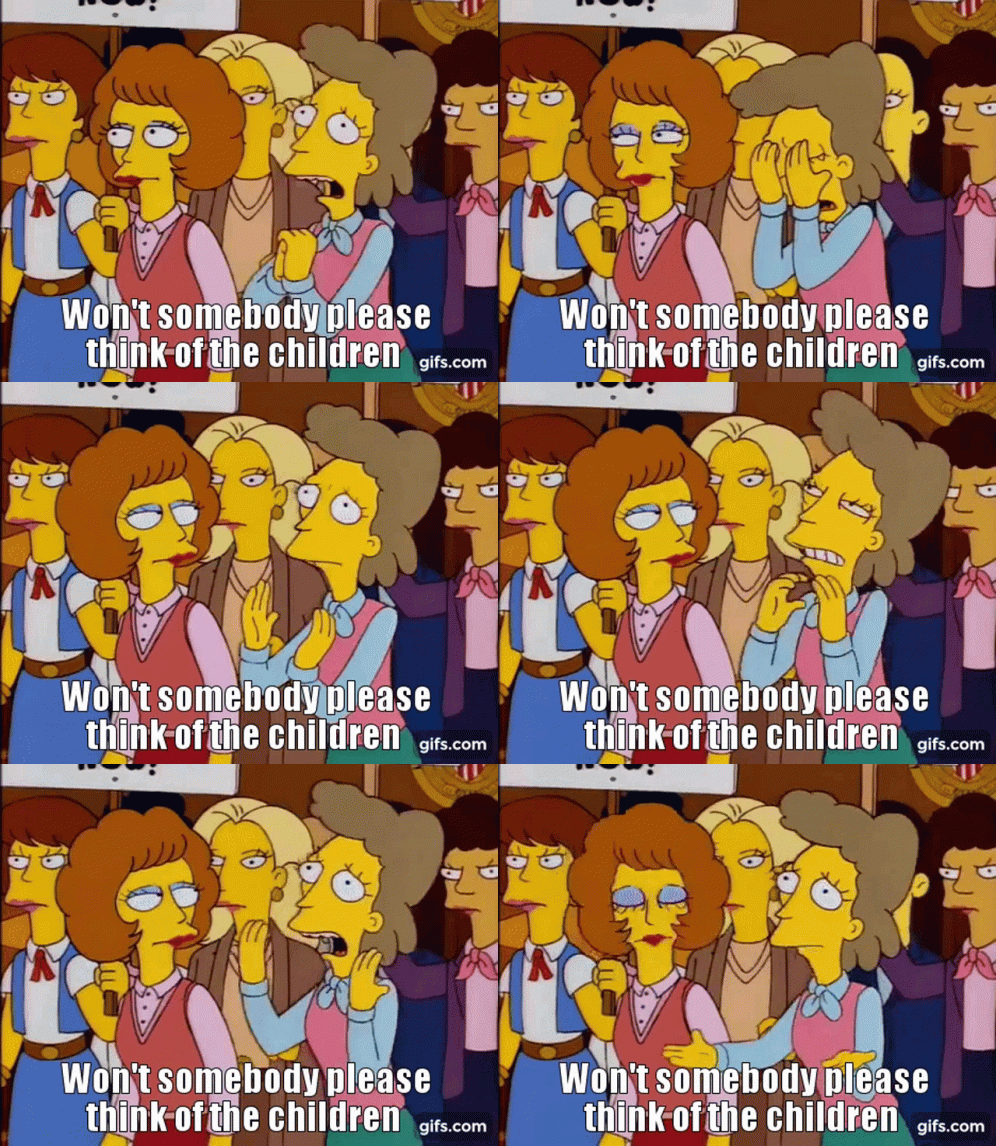
It’s extremely disheartening to find those of my generation (or any, really) are still espousing the recessive ideals of the past and trying to hide behind a “hate the sin, love the sinner” mentality or “won’t somebody please think of the children!!!” …

… like queer people don’t also have children (or gasp the queer children of non-queers) they’re trying to protect from hateful comments and actions. Call out those hateful comments, and you’re putting the “Gay Agenda” before children’s safety.

Ban this, all because I don’t agree with it, but say it’s for the children. Ban that because I think it’s icky, but say it’s protecting women. Don’t actually protect the children or women, though, because then we’d actually have to do something.

BTW the gay agenda is to exist without being made political or targets of violence, so we’re obviously failing at that every day.

People existing, who have existed for years, decades, and centuries, are “political” because it’s been brought back as another thing to point fingers at for problems. We’re easy targets when we look different from others. We look different when we stop lying about ourselves.

We look happy when we are not lying about ourselves. Yet not lying about who I am is seen as political. I’m existing in my own life with my own goals and not forcing my life on anyone, but I’m told that I’m pushing the “Agenda.” By existing.

I’m “political” for just existing because my existence means that someone out there has to not treat everyone as if everyone thinks the same. And this offends some people to the point that they want to attack the “agenda” I’m pushing by existing.

This has gone on for centuries, through all of human history, with any number of groups being othered for existing. Ignore the man picking your pocket, there are two men kissing IN PUBLIC! There are people of color who are DOCTORS! PRONOUNS! All because they want to blind.

People who can otherwise be intelligent can fall to bias. They want an explanation as to why things are not going their way and someone comes along and says, “That group over there is why.”

Why are women assaulted? They say it’s transwomen and drag shows, though there’s plenty of documentation and studies showing that it’s more likely an AFAB person will be assaulted by someone they know.

Why are children and young adults groomed? They say it’s the “gay agenda”, but it’s always lecherous people who are enabled by those around them or their status, regardless of sexual or romantic orientation.

These crazy people think that anything LGBTQIA+ is sexual because they cannot fathom that deviation from a cishet relationship is anything but sexual. Why do groomers groom? Sexual reason. Why do trans people transition? Must be sexual, too.

My transition is the opposite of sexual. I grew up being told what is masculine and what is feminine and that as AFAB I need to do the feminine things. I never fit the media representation of girl or feminine, so I assumed, for decades, that I was a failure at life.

Exposure to LGBTQIA+ media, literature, communities, etc, introduced me, at 30+ years old, to the vocabulary and understanding needed to find out how to put into thoughts, words, and actions what I truly feel like. I’m neither masc nor femme. I don’t want to be either.

Pride events bring that kind of awareness to everyone, regardless of their identity. Maybe you feel like, after seeing that there’s support out there, you identify with something other than what you’ve been told to be all your life. Maybe you don’t.

Maybe you see it all and just think, “I’m glad they’re happy, but I’m fine how I am,” and that’s great! LGBTQIA+ isn’t a faction that you have to join or fight against. It isn’t even a cohesive group that shares all ideals. There are racist gay people, and anti-trans lesbians.

There are assholes in any group. Identifying as something doesn’t mean you have to adhere to all things related to that. That’s why there’s not actually a “gay agenda” and why it’s so easy for bigots to cherry-pick what they want to attack about LGBTQIA+ people and events.

“Won’t somebody please think of the children” my stawman cries as they plead for everyone else to attack their strawman.
GIF of a scene from The Simpsons - woman pleading, "Won't somebody please think of the children?!"

Meddygon (they/them) 🏳️‍⚧️
@meddygon

This was originally written before the COVID-19/Coronavirus pandemic was full blown in the US. It feels extremely petty now and I’ve lost all steam on finishing it. Suffice it to say, I enjoyed this book and do recommend it to all to read, even if the troubling times depicted seem prescient to the current situation. What is happening now was inevitable, but unlike Station Eleven’s “Georgia Flu,” is survivable.

I first heard about Station Eleven when the author, Emily St. John Mandel, when it was announced that she would be speaking at Cleveland State University. I wasn’t able to attend, but the professor that told me about it said the book was about “a post-apocalyptic theater troupe around the Great Lakes.” I bought the book immediately, because that’s just my jam. I didn’t get a chance to read it until after graduation. I am so glad to have done so— This book isn’t about just the theater troupe. It’s about the dread of the unknown, the collapse of structure, and the rebuilding of life with the rubble that remains. I don’t think I could have appreciated the way St. John Mandel expresses anxiety that freedom brings without recently being freed from something myself. This will be the first time I’m writing about a book that I wasn’t required to read for a class. This is the first time I am writing about something I read for my own enjoyment. This the first time I get to write about my thoughts on the primary source without having to cite several scholarly sources to support my point. I don’t need a thesis. I don’t need a conclusion. All pretension and pseudo-intellectualism is gone! Meeting standards set forth by people who have no direct impact on my personal edification just to prove that I’ve memorized the prescribed literature is gone! No more bullshitting to fill a page-length on a topic I don’t care about! It’s as if all of society has collapsed and I’m now free to do whatever I want! Oh, did I just … I just made a thesis, didn’t I? I don’t care if it’s weak! I don’t care if I don’t prove it! Fuck you, I get to slack now!

Read the rest of this entry »

Oftentimes, the reader that could benefit from reading a work of literature that is intended to develop empathy for a particular plight is not likely to pick up a book that clearly advertises itself as being about that hardship. Many authors have tackled this obstacle in the past by writing speculative fiction rather than a straight narrative. The time-travel aspect of Octavia Butler’s Kindred might draw in the temporal enthusiast, but her message is still overtly about the struggles of African-Americans. Jesmyn Ward’s Sing, Unburied, Sing is a fantastic ghost story that is still straight-forward about the poverty and incarceration related suffering of African-Americans over several generations. However modern authors approach this minor subterfuge of “tricking” a reader into ingesting their message of social justice, there will still be a group of people that have no desire to pick up a book. This is where new forms of media, not just modern writing, come into play. Television and film in recent years, especially those based upon novels that have a message of social justice, reach more of an audience than just fans of the book. Video games, especially those developed by independent studios, are in a unique position to deliver the audience a perspective they would not normally have sought on their own through the allure of gameplay. One such game I will focus on is This War of Mine, published in 2014 by 11 Bit Studios. The game uses a popular game style from the time—Survival—to deliver a specific message about the lives of non-combatants in a military conflict. The tagline of the game (“In War… Not Everyone Is a Soldier”) provides the player some foreshadowing that the game is atypical.

Read the rest of this entry »

A Room of One’s Own

The below text was written for a class on British Literature, focusing on Virgina Woolf’s “A Room of One’s Own”.

Lately, I feel like I’ve been living the reality that Woolf describes regarding women and fiction – obligations from being a woman, a mom, an aunt, etc, have to be juggled with my schoolwork, my job, my social life, any an personal or free time. It’s overwhelming. And then, I have to decide, what do I prioritize? If women lack the education to write poetry, as Woolf says, should I then prioritize education? But what do I take from? Do I stop performing the  “duties” of my gender? (This is actually what I did—I consider myself non-binary in the first place, the “performance” of femininity never sat well with me, neither did masculinity. Supportive spouses are great.) Does my education suffer because of other things required of me? (If you look at my post history, you’d probably see that I don’t often get time to post, or even to think of what to post beforehand. Full time jobs are pretty much necessary for middle class parents of any gender.) Do I stop working, or take time off, in order to make time for other things? But then how would I get my “£500 a year” to afford life?  The mental labor necessary for finding time, the freedom to be able to write, and to write something that requires as intensive scrutiny as poetry, is still not afforded to women (or even men) at the present time. Prose and poetry are still something afforded to people who have an abundance of personal time, or to people who are willing to sacrifice necessities to make time.

Read the rest of this entry »

I’m stuck on one line Maggie Nelson wrote on page 37.

I cannot hold my baby at the same time as I write.”

This is something that I feared when I became pregnant, when I decided I wanted to have children. I wanted more than one before I had one; but having one has made me realize that, mentally, I cannot handle more than one. And I think it is because of this sentiment I share with Nelson.

I cannot be a proper mother while being myself.

Nelson references her quote of D. W. Winnicott that echoes how I felt with “I had nearly four decades to become myself before experimenting with my obliteration.”

I don’t think I had that. I think I was still striving to find who I was before I had my child, while I was pregnant, and even after he was born.

Women struggle with identity in ways that men will not understand. We have feminists telling us to be ourselves, to make our own decisions, to do what we will, to find our own truth of life. We have the patriarchy telling us to be good and start a family while we can, before complications arise from age, before whatever. Before we’re whole. Be a mother before you’re human.

Read the rest of this entry »

While I plan to finish the entirety of I’m With the Bears shortly, I am still on a deadline because this is for a class.

I spent yesterday at a relative’s house for a family reunion, in the 94°F (34.4C) heat (“feels like: 100°F” (37.7C) says the Weather Channel) when outside, in something significantly cooler but still warm indoors. Air conditioners that once made the interiors of houses comfortable can only manage “better than outside” in the summers now. Living in a house without central air has gotten me used to sitting in a room that runs around 80°F (26.6C) as the tiny, single-room AC unit in the window struggles to counter the increasing summer temps.

It was James’s side of the family, so the reminiscing was not for me. I hung around with those that married in and we discussed things. The conversation was usually about jobs, status of vehicles, the temperature outside. We talked about how hot it is, how it used to not be that hot, but there was no discussion deeper than that. This wasn’t the time or place for it. It was too hot.

My job as an energy engineer/analyst/manager for retail corporations fits snugly into this changing climate. My goal is to save them money by running the AC efficiently. Making stores comfortable so people buy things. On the surface we can tell people that we’re trying to be more environmentally friendly, but it’s all about money.

Read the rest of this entry »

Last Christmas, I think it was, I bought a copy of Paolo Bacigalupi’s The Water Knife for my brother in law (it was on his wishlist) and didn’t bother to peek inside. I know now that if I would have, I would have ended up giving him a used copy.

I often wonder how I got into the business of energy management—it was completely by accident, I swear. I got into tech support for the company’s lighting and HVAC controls systems, learning much of not only the workings of the hardware and software, but also of the strategies. I’m interested and invested in all sorts of resource management as well. My career requires that I find ways for retail corporations to save money on utilities, but the way to do that is to use less. Less electricity. Less gas. Less water.

It seems like the main characters of this novel each also got into caring about water management by accident as well. A hardened criminal recruited from prison by a corporate mastermind. A “wet” (newbie) reporter trying to shout out the truth to people who don’t want to listen to it. A refugee just trying to get out of her shitty life.

Though the novel follows a fairly formulaic story telling process, the characters are still interesting and their motives are more than just a stereotype. Bacigalupi builds a world based around water scarcity that is based on real issues affecting the American southwest today (and has been for more than a century and a half, really) and takes it to a dramatic extreme with political and corporate espionage, shadow ops, and people who got in deeper than they wanted and now they’re all in danger.

Highly recommended, and would love to see a movie.

I will admit, I did not read the whole of The Rules Do Not Apply by Ariel Levy. I have been busy at work, getting back into the swing of things after being off for a week recovering from surgery. I skimmed the book, found a few short chapters that struck my interest, then ended up going back to find out who people were and what was going on. I was mainly interested in how Levy spoke on her miscarriage.

Miscarriage and infertility affect the majority of women, but seemingly are never really discussed. By discussing it emotionally, viscerally, socially … Levy is making a big feminist move. It’s a thing that can only happen to people with uteruses but no one talks about it because it’s a “women’s problem”.

I have my own issues with infertility that I haven’t really discussed, even with those closest to me. I usually just give them a run down version – physically incapable, my meds prevent me, something like that. I’m 35 now with a 9 year old, and I’ve not “given up” on trying to have a kid, I’ve realized that I don’t actually want another kid. I didn’t really want a second but convinced myself that I did because my spouse did. I’d have to get off my meds in order to attempt again, and we tried. I can’t handle my mental issues without my medication. We discussed this  between ourselves and both agree that we’d rather I be a human being than a baby factory.

I’ve had friends deal with miscarriages, and it’s a difficult feeling to know you’ve done everything right and it still goes wrong. I think that’s part of what Levy means with the rules not applying – you follow all the rules to do what you want, and it still goes wrong. Most rules are just best guesses anyway. I’m reminded of a great quote from Star Trek: The Next Generation from Picard that stuck with me for a long time: “It is possible to commit no mistakes and still lose. That is not a weakness; that is life.

A quote from last week’s email from the professor for this course:

THINKING ABOUT BLOGGING

As we hit the midway point of this course, it may be valuable to you to blog about blogging: what is it like to write online about your writing, in this (somewhat) public way? Have you blogged before this course? Why or why not? How does knowing you are going to blog about these books affect your reading?


I said in a separate conversation with the professor that I’ve been blogging since before blog was a word. That may be a slight exaggeration. I have definitely been blogging since before blogging was a profession. The word blog, short for weblog, came around in the days of online diaries. The anonymous over-sharing that came around first on people’s private web pages, then on sites such as livejournal, myspace, friendster, xanga, tumblr, wordpress, facebook, twitter, and whatever else will come in the future. I’ve watched platforms come and go. I’ve watched online friends come and go. I’ve followed the lives of people I’ve never met, and people who have never met me followed my life.

Look at the side-bar. There are posts dating back to 2000. They were backdated on this wordpress (installed 2007) but have been part of my life, my site, since the 90s. I’m ancient on the internet. I’ve been making my views known to whoever will read them for 20 years or so. It was new then. I was a nerd for doing it then. It’s just part of life now. Not just for me, but for society in general.

The only manner that knowing I have to blog for this course (and for other course(s) taught by this same professor) is that how much of non-academic me do I want to let bleed into my writing?

  • I am used to writing academic papers.
  • I am used to writing blogs.
  • I am not used to blogging academically.
  • I am used to writing gigantic blustery papers that take ages to get the point.
  • I am used to writing short, witty responses to media I’ve consumed.
  • I am not used to writing short-form responses to things I have read for an academic audience. 

This has been a fantastic writing experience for me and I absolutely enjoy it. I don’t know how many people, if any, are really reading any of this (my site stats tell me it’s not many at all—my dealings with Valve’s foreign transaction fees continues to be my most read post). I can only hope that those who come here for my writing for classes stay and read my other writing (and try not to judge to harshly what 15-25 year old me wrote).

In her novel Future Home of the Living God, Louise Erdrich grasps and explains some rather important parts of the apocalypse: Humans known not the scale, and indeed prefer to not know (even with all their clamoring to just know), the scale of the end of life as we know it. The format of the novel as the main character’s journal gives the reader the fog an individual would have—unlike many others that offer flashbacks or other points of view that provide the reader with knowledge that the characters could not possibly know. When a global scale crisis arises, the people immediately become small-minded: looking out for themselves, their families, and little else. Those with power seize control of the military, communication, production, and reproduction. Their agenda is thinly veiled with euphemisms that imply comfort and protection, but masks the abuse of women. The abusers are themselves against what they do but have no choice themselves. No one is winning in this situation, even those that pretend to be in charge. It’s the end of the world, and no one wants to notice.

The focus of the book, however, is an individual’s journey in hiding from those in power, being captured, escaping, being captured again, and ultimately [spoiler alert] not getting away or what she wants. “Finally!” I said to my husband after I finished reading this, “A dystopic novel that doesn’t have a happy ending!” In most stories, there’s some morally gray “happy” ending that gets the main character(s) what they want but with some sort of sacrifice. Here we have a main character that loses everything, and remains that way at the end, with no hope in sight. This is what a reader needs in order to truly understand what the end of the world would be like. No one wins.

Several times within her journal, Cedar (the main character) writes about her future child’s growth, musing over the large numbers and small scale of each bit of growth. She admits that it all seems meaningless, but somehow important at the same time. Just like the end of the world—just like any other hyper-object—it’s too large or to small to comprehend, so she focuses on things that are her size. Her relationships with her moms, her dads, her sister, her grandmother, her “angel”, and the other pregnant women she meets along the way are what drives her. The crisis is endured by all, and so is not a concern that is discussed. It is there, all are aware of it, but every faction moves on their own for their own means. There’s no one group trying to save all of humanity, even those that they they are doing so are trying to create their own world.

The premise behind Dear Ijeawele, or a Feminist Manifesto in Fifteen Suggestions by Chimamanda Ngozi Adichie is what to do to raise your child a feminist and/or be a feminist while raising a child. Hot on the heels or reading Crispin’s so-called manifesto, I was thrilled to read something that actually added to the conversation of Feminism without just being an angry rant. Angry rants are for blog posts (see my previous ENG 363 for a prime example), not for printed publications. Those poor trees that suffered for Crispin’s independently published diatribe, may their spirits haunt Melville House for eternity.

My goodness does Adichie get it right; and by “get it right” I mainly mean she echoes what I already have decided is the best way to raise my child. She reminds her friend that she is more than just a “mother” and that “mother” does not mean “primary caregiver”. The first line that struck me and made me want to quote it is “The knowledge of cooking does not come pre-installed in a vagina” (15). Damn straight it doesn’t! I can’t cook for shit! Even with mail-order recipe and food services I still can’t cook! I do not have the mental energy or attention span to do it at all! My husband does all the cooking and I love him so much for it. We started our life together cooking “equally” but soon realized that doing half of the work drained more out of me than him, so we adjusted.

The suggestion to abolish/ignore marketed gender roles is an absolutely important one, and one I absolutely live by. My son has a dollhouse (which no one in the family would buy him for Christmas, so we bought it for him afterward) in which live action figures, Funko Pops, dolls, and papercraft Minecraft animals. He rarely plays with it now, but it was an interest of his for a while to have Anna and Elsa living in the house, Doc Brown in the garage, and Groot in the yard, and so on. While he may be embarrassed at school to mention these things, we remind him that not everyone realizes that children can be “as much of a boy or girl as they want” without ridicule, and so they likely ridicule their kids or condition them to be ready for ridicule. Like Adichie suggests for her friend’s daughter, we don’t measure our son by how much of a boy he is, we measure him on how much of himself he is.

Adichie’s “Feminism Lite” is given a short section in suggestion four, but it is an important one. The idea that men do, and women are “allowed” to do, is insanity. I do not work because my husband “allows” me, I do not create art or write because my husband “allows” it. I do it because it is who I am, and he is supportive of it (and as Adichie points out, “support” is what women do). I’m reminded of the phrase, “Behind every great man is a great woman,” because it implies that a woman should be grateful that she is supporting a man.

“Feminism Lite” also bleeds into much of the rest of the letter/book, especially in section six in which she says to question language. I’m reminded of an article from 1933 about Freda Kahlo, headlined as “Wife of the Master Mural Painter Gleefully Dabbles in Works of Art“. I can 100% assure you that I have never learned about Kahlo’s spouse in art history, but I have always learned about Kahlo as an accomplished artist (and, to point out, not as a “woman” artist, but an artist outright). I have a mohawk and dye my hair, I get tattoos. I sometimes get asked what my husband thinks of it (he loves it, though he would not do any of this himself) and I reply, “he helps me with the hair.” I do not acknowledge what they’re seeking to find, that he “allows” it or that I am “rebelling” against him, but skip to the implication that he’s fully supportive of me being myself. The most important take-away from this section, though, is “Teach her that if you criticize X in women but do not criticize X in men, then you do not have a problem with X, you have a problem with women” (27). This is something that needs taught not only to children, but to adults, to managers, to people in power, to the media, to everyone, everywhere. It is something that I sometimes have to remind my manager; I am a woman in a male-dominated field (as an aside, I am an artist and writer, but I am employed in an engineering role and do my job quite well). He may be enlightened enough to know that my gender has no bearing on my skills (just as my hair, my tattoos, etc. equally have to effect on my work) needs to listen to criticism from my coworkers about me and take into account that they may not be on the same level. Are they complaining that the behavior is wrong, or are they complaining that a woman has behaved that way?

I am glad that Adichie address the ideas of sexuality and romance as well as the shame and insecurity that come from discussing it. I see too often in feminist literature that these ideas are brought up, but not truly discussed. Relationships between two people, whether the heterosexual norm or not, should be about communication and mutual benefit. Femininity is too often about sacrifice and Feminism is too much about about not-sacrificing. Rarely does Feminism and Relationship discussion come down to actual interpersonal communication, authors opting more often to take an us-vs-them approach that echoes the misogynist viewpoints found in history. Turning a bad thing upside-down doesn’t fix it.

Adichie’s central feminist message for the child and mother is that “Be a person, a whole person, and do not define your self, your worth, or your choices by what society says you, as a woman, should do.” She doesn’t once tell anyone to “Just Stop” being a certain way, but rather accept that everyone come from a different place and has different hurdles to cross, and that their choices are their best choices. You can have opinion about things, but you cannot force your views upon someone – you cannot make them “Just Stop” as Crispin would love to be able to do. Adichie’s manifesto is much more useful for feminism, and for humanity. Though her background is far different from mine, her advise is universal.

ENG 350 – “The Road”

Last week I read The Road by Cormac McCarthy. To keep with my theme of comparing the novels I read for class to video games, I’d love to compare The Road to The Last Of Us (Naughty Dog, 2013), but I’ve never played the game. I only know its a zombie apocalypse game that focuses on the main character transporting a young girl to a safe location. Its a game I’ve meant to play but never got around to, and like The Road, the narrative is more about the relationships than the state of the world.

Though the class focuses on climate related fiction, I don’t feel that the situation in The Road is strictly climate fiction. It’s about the old fear of nuclear winter rather than the new fear of global warming. It focuses more on the powerlessness of the main characters at the hands of other humans than the uncaring universe. Don’t get me wrong, the uncaring universe is there, but it’s there for everyone. When something is so ever-present, it ceases to be a worry, and more of just a concern. A factor that must be taken into account rather than directly planned for.

In The Road, the man (who is never named, other than “Papa”) is entirely concerned with protecting the boy (his son, who again is never named). This protection ranges from tending to his physical needs (food, water, shelter) as well as his metaphysical ones. The man fosters a kindness in the boy that, even as the boy begins to call out the hypocrisy of the man, the man still insists the boy must adhere to. This echoes much of the world as is—”Do as I say, not as I do”—where people martyr themselves so that others don’t have to. It’s always wishful thinking in my opinion, as everyone must always survive, and protecting people in this way sometimes makes them unable to care for themselves in morally ambiguous situations.

The relationships between the main characters and other characters, however brief, are as important as the relationship between the main characters themselves. When two people have only each other, they can say whatever they want, but when a witness comes around, their attitude changes. The boy hints near the end that the stories the man told him about being the good guys are just that—stories. Lies. A mask the man wants to wear in front of the boy. But when others come around who are just as desperate, the boy wants the man to wear the mask, but the man knows the mask is flimsy and won’t protect them.

The end is “happy” in a sense, in that the boy won’t be alone, but we also don’t know his future. To truly be a dystopic story, though, I think the boy should have suffered alone longer. Not that I would wish that upon anyone, but the boy went from one protection to another—and honestly, when would that ever happen? Does it even happen now?

The readings for this week were the “Race and Entertainment” section of Bad Feminist by Roxane Gay and “Moving Beyond Pain” by bell hooks. One of my classmates touched on a point I previously hadn’t considered regarding these two takes on pop culture representations of race and women. There is a lack of diversity while being diverse. Shows with a diverse cast but not diverse roles are often lamented by actors of color.

I am reminded of the plight of new actors, which I’ve seen explained by Carolina Ravassa on her youtube channel Hispanglosaxon. While most of the episodes focus on her issues with being “too white to play Latina, and too ethnic to play white,” she also discusses on, when being cast to play an “ethnic” role she is often expected to play a hyper-sexualized service role (see season 1 episode 9). While shows may be casting people of color, they’re still casting them into the same, tired roles. Though it may be the entire cast (in the case of Lemonade), hooks laments that they are playing a stereotypical role (the body as a commodity in the background). With Orange is the New Black, there is a diverse cast (some latina, some african american, etc) they are all, still, some sort of criminal.

Jonny Cruz, another actor of color, in an interview at a convention was asked what to do when offered a role that perpetuates a stereotype. He admitted that he once took a role of a “thug” or “gangster” early on because he needed the work, but it made him feel awful. He knows he took the role because he needed a job, money, experience, etc, but he’s refused to do similar roles ever again. His advice for other new actors of color is to know that if you don’t feel right about a role, you do not have to take it. If you do choose to take it, you do not need to feel bad about perpetuating a stereotype so that you can eat. It’s a difficult position that the media puts minority actors in, but there is some solidarity and understanding in the actor communities.

In my previous post regarding Edan Lepucki’s California I mentioned the symbolic “newness” of the turkey baster and the meaning Frida attaches to her other artifacts.  There are several times where objects—possessions—are triggers for memories or behaviors for Frida and Cal. These same objects, when handled by others, affect the characters. The Bee that Frida finds in Micah’s house meant so much to them as children and brings back pleasant memories for her, but to Micah it is just a tool. Micah understands what artifacts mean to Frida, though, and has August bring back her collection from the Miller Estate. But again, to Micah, they are just a tool to control Frida’s reactions. It’s entirely possible he left the Bee out for her to see. Micah uses Cal in the same way, but targets his ego rather than objects. He know Cal will be chuffed to part of the inner circle; to be let into a room that not even other members of the inner circle get to be in. He gives Cal/Gray an assignment on the inside to keep him in line; to make him feel special. He gives Frida/Julie all the objects of a “normal” life she could ask for.

I don’t particularly like that Lepucki echoed the stereotypes of men and women in the Land, especially after deriding such separations in earlier chapters. Frida willfully enters into “women’s work”; baking, cooking, gossiping. Cal continues with manual labor, security, and intellectualism. What does Lepucki mean to say about the end of the world, or the nature of humanity, by having her starring roles be held by such stereotypes? Even with Sandy, a pioneer through and through, she cared for the kids and did laundry and even pressured Frida to have a child. Bo did the hunting. The labor. “It’s about upper body strength” was used more than once in the novel to explain why Men do certain jobs.

While neither Frida nor Cal’s skills are presented as lesser than the other, the Land still has a clear distinction of how women work/behave/think and how men work/behave/think. Cal collected information from discussions. Frida, from gossip. Cal proved his worth by working. Frida, from bribery (with baked goods). While it could be said that these character choices are just these characters and how they would behave, that doesn’t explain the remainder of the population going along with the same ideals. The Men were in charge. The Men did security outside, the Women inside. The Women used sex to persuade Men. There were jobs that were co-ed, such as the construction, but the one woman in it was considered a shrew for wanting things measured. The men in cooking were considered inept.

My fear with any feminism class I take and any feminist book I read is that I’ll be beaten with the two-by-four of feminist rhetoric telling me how awful I am for not embracing the gold-star feminism of hairy-pits and man-bashing. It seems Roxane Gay has this same fear. While she starts the book with essays about herself, she goes on to discuss how pop-culture has skewed her view of feminism and how it could (and does) skew others’ views as well.

I am particularly taken with the essay “Garish, Glorious Spectacles.” I’ve long considered gender (masculinity/femininity) to be purely a performance. It’s an act one puts on to get responses. I’ve never been attached to either femininity or masculinity, having spent much of my younger years being told I was a “tomboy” for liking the things I liked and never really having much interest in the script for “girl”. My lovely housemate found that she also didn’t have much interest in the script for “boy” growing up, and now is finding that the script for “girl” doesn’t quite fit either (but moreso than “boy”). She revels in her ambiguity now, and as I told her I love seeing her happy, “You make others as confused about your gender as you are!” Gay’s readings of “Green Girl” et al affirm/confirm our right to be confused about ourselves by showing how the media portrays the “act” of woman. We know what we are, yet here is a popular TV show showing us what we say we are is not the definition they want to portray. The stereotypes of women are entertaining—an actual woman is human, normal.

Gay’s “Not Here To Make Friends” elaborates more on the stereotypes of women in media negatively affecting women in general. A woman who is portrayed as independent and bold is unlikable, but the same for a man is the ideal. Such it is in life – a woman in leader ship is bossy while a man is just the boss. The essay goes on to to say that it’s foolish to thing of a character needing to be likable to be a good character, man or woman, but a man often gets a bye as the “anti-hero”. A woman is just a bitch.

The opening of California (by Edan Lepucki) has been refreshing. Growing up with media such as Captain Planet and Ferngully, I’ve been inoculated against the over-the-top personal pleas for the average person doing what they can to fix whatever is wrong with the environment that week. If you, average American child, do not recycle that can, you are leading us to the environmental apocalypse! California acknowledges that the problem isn’t the average American—it’s the rich capitalist, the corporation—that’s causing the problems. It is, however, the average American that suffers.

Frida fawns over her artifacts, including the like-new turkey baster, as reminders of what life was before it began to end. Though as the story progresses, we learn that the end was already there. The irreversible causes had already had their effect, and it was just a matter of time before everyone felt them. Resources became more and more scarce, and only the rich could afford them. Frida’s artifacts seem less like symbols of what her life was, but more like what life should have been had humanity cared enough to not destroy itself. It’s more of a hope that they could return to the ideal, should they come across some wonderful fix or some way to get into the Communities.

Naming their plot of land the Afterlife is a bit like holding on to her collection of objects. While the move there was Frida and Cal’s abandonment of the world, they still call it something based on their interpretation of the world. But the name also shows their acceptance that they really can’t salvage the world in any way. To not call it “Eden” is an admission that the move was not for a new beginning; it was for a new ending. Rather than be just another body in an alley outside a hospital, unable to afford care, they chose to be away from everything and care only for themselves. They threw themselves to the wild knowing full well they could not tame anything.

Lepuki’s descriptions of the wilds reclaiming urban centers and man-made objects makes something extremely clear about global warming and its effects on humanity: the world will continue even if we cannot live in it. Super-storms and other “acts of God” are already present and destroying civilization’s mark upon the world; they’re no different in California. Cal’s parents in Cleveland succumbed to harsh blizzards and the west coast is devastated by other natural events. Being able to ignore it is a privilege for the wealthy, but they are only ignoring what will eventually happen to them.

Reading the beginning of this book I was reminded often of the Fallout series; an eternally wasteful USA drains the world of its resources and goodwill, and succumbs to the events they cannot control. Though it is nuclear war in Fallout, the anarchic, community-based societies that follow the destruction are similar. The isolationists, the raiders/pirates, the feral communities are present in both the Fallout games and California.

Frida and Cal’s devotion to each other is not total—while they are clearly not physically unfaithful, they each, for their own reasons, choose to keep their emotions and thoughts from each other. It is strange that they would do so considering a fear of what the other might think (such as with Frida’s drug use) is a product of a society in which they no longer participate. Even marriage is a relic of this society, just as Frida’s artifacts are.

There is so much that can be said even in these first few chapters about Lepucki’s take on what would happen during the social apocalypse, especially since I haven’t even mention Micah yet. Micah (and his supposed death) is a huge catalyst for both Frida and Cal in the story; his return in chapter 8 intrigues me.

I’m enrolled in two English classes this summer that require blog posts for interaction. I’ll be putting them here on SDO with tags for each class—ENG350 for Dystopian Lit and ENG363 for New Feminist Memoir. Use the links here or below the post to find all writings as they are posted for each class.

Dental Issues

Back in January, at my 6-month dental cleaning, the x-rays showed I had a cavity. My first one ever. I went along with the suggestion to get it drilled and filled right away, and within two weeks I had some white resin where there had been solid tooth before. Almost immediately, I had cold sensitivity on that tooth. I figured this was part of the healing process – and the internet confirmed it – so I waited.

Two weeks later, it was still there, but not getting any worse. I saw the dentist and they took new x-rays. It showed that the filling was close to the nerve, but it should heal up soon. The dentist said it might take longer than expected because the drilling had gotten so close to the nerve. So I waited.

Last week, I had my next 6-month cleaning. I said that the temperature sensitivity is still there; hot or cold. It’s not debilitating, but extremely annoying. I asked what my options are. I could get a root canal, which would leave much of the original tooth but remove the nerve. Or I could get the tooth extracted, which would obviously leave a gap.

I went with the extraction. The tooth causing problems was my back left molar. It was at an angle in the first place, so it was barely used. I didn’t care about retaining any of it. The dentist didn’t pressure me into the root canal, and I set up my appointment with their dentist that does extractions.

The next week, she looks at the x-rays and asks if I’m sure I want to get the tooth extracted. It’s a perfectly healthy tooth, she says. I explain that healthy or not, there is cold sensitivity that has been annoying me for 6 months and has gotten no better or worse. It has to go. I’m not wasting my time on a root canal that might end up in an extraction later.

She numbs me up and removes the tooth. Quick, painless. I ask her for the tooth. She says she’s not allowed to give it to me, but if she set it in a cup and looked away, she wouldn’t know what happened to it.

After the extraction was paid for, I drove over to my husband’s work and we took a short walk around the towpath trail. My face was slowly losing the numbness. There was some swelling, but not any real pain.

Later, I washed off the tooth that was removed and examined it. At the edge of the filling, on the inside so that when you took and x-ray you couldn’t see it, was a cavity that was the size of the filling. The dentist had missed part of the original cavity, and it either was still there or had spread.

I’m glad I got it removed.

Spider Bites

I’ve been researching various spiders recently because I’ve been trying to find out what bit me, and I’m fairly certain that it was the brown widow. We’d seen the spider around the bathroom previously, and she kept to herself. She had that definite black widow shape, but with a big brown booty instead of being shiny black. Her web was a disorganized mess, but she was collecting carpenter ants like crazy so we let her stay.

A few days before the bites, I noticed she was gone from her usual spot behind the toilet, so I just assumed she moved somewhere else after exhausting her supply of carpenter ants. I was right, and late Wednesday/early Thursday, I found out where she’d gone. Apparently under the headboard.

The way I sleep, I put my arms under my pillow, and occasionally my hands will be in the space between the mattress and the headboard. Our mattress is about three inches or so too short for the bed frame, so we have quite a bit of space there. I’m assuming she got herself somewhere around there and was just startled by my hands.

I woke up Thursday morning around 1 to 1:30 chewing on my right ring finger. It was itchy and swollen, and in my sleep I had started trying to scratch it with my teeth. At the time I assumed it was a mosquito bite on my knuckle because I’d heard one buzzing around before I went to bed.

I stayed in bed and tried to go back to sleep, but the itchiness just continued. After a while, I could no longer feel the pillow with my ring or pinky fingers. I could only feel itchiness. I got out of bed and ran my hand under cold water for a while. I noticed that I had a few spots where my teeth had broken skin, probably from my eczema blisters that were stretched out from the swelling. I used a washcloth to scratch my finger so I wouldn’t tear the skin.

The swelling of the finger was enough to keep me from closing my hand all the way. The itchiness had died down enough that I could go back to sleep, so I did.

When I got up in the morning, the itchiness was gone, but my hand was still swollen. I got out of bed and the first thing I noticed was that my right leg did not want to work. A tendon on my right knee felt like it was swollen and would not let me bend my leg without pain. James got me some ice and did the driving for the day. My leg pain did not subside, even with pain killers. I had a strange pain in my left collar bone as well. I didn’t really think that all of these were connected because I still thought it was just a mosquito bite.

I spent the day trying to find out what could possibly cause this. The results came up as widow spider bites. There are several kinds, but people only seem to fear the black widow. The articles I found said this is because the black widow will inject much more of her weaker venom, causing more pain. The brown widow, and the other widows if they bite, will use small amounts of their stronger venom. Brown widows are an invasive species, new to the US and not common enough in Ohio to be listed as having the state as in their range. Everything I read fit, but I still had my doubts. There were bites from mites and other things that could possibly have similar effects.

That night, the swelling in my hand was down enough that I could actually tell where the bites were. One just under my ring fingernail. Another about two inches down, below the knuckle. Yet another about four inches down on my hand. And another one about six inches down that on my arm. My left hand has one bite on the index finger and one on the middle finger, below the first knuckle. Those ones didn’t seem to have any ill effects other than redness and itchiness.

I began to look at various bug bite pictures, trying to confirm what was going on. Nothing I looked at really matched until I got back to widow spiders. I don’t know why I doubted it so much, but this is really all it could have been.

Friday morning, the pain in my leg had spread a little. Rather than just being the tendon at my knee, it was now my calf muscle and a muscle in my thigh. I went to work and kept my leg propped up, but then my left shoulder started to get the same pain. At one point, I went to the rest room and found another spider bite on my right thigh. That’s what convinced me it had to have been a brown widow. My right knee having pain wasn’t something unrelated to the bites on my hand. I found a bite on my left elbow later.

I left work early and just chilled around the house. I read more on brown widows, trying to ID the spider in the bathroom from memory. I was at the point where I couldn’t tell if my memory was helping me find the spider by looking at images, or if looking at images was molding my memory of the spider. I remembered the big booty. I remembered the size. I remembered the web. That matched. But the hourglass? I don’t remember seeing that. I don’t remember seeing the designs on the abdomen. I don’t remember the stripes on the legs.

Friday night, as James and I were about to get into the car, I noticed a spider in the window of the garage. She had the booty. We looked at her, and based on what we’d both seen about brown widows, we’re certain that is what bit me EIGHT FUCKING TIMES.

The First Meal

I never meant to kill my first one. It was passion first, an accident second. After that, though, all intentional.

I lived as a wanderer, always. To succeed in my detached lifestyle, I needed to acquire certain skills. I could have, like many other women in my position, fucked my way to safety every night. Don’t get me wrong, I’ve had my share of whoring, it works. But these girls who did it exclusively were being taken advantage of. I don’t like being the weaker party.

I was a robber, mostly. I’d sneak in, or I’d worm my way in through pity or smarm, whatever it took. If I got nothing more than food and supplies from the people, I was happy. I never took more than I could use or sell quickly. I wasn’t looking for riches, I just wanted to be in charge of my own life. If things got too hot to handle, I’d bolt. Someone woke up, or confronted me, I’d drop it all and cut my losses. I’d never fight; I didn’t count fighting to be part of my skillset. I was a coward, truly. A mouse stealing bread crumbs from the pantry. My skin was worth more to me than whatever I was taking.

I was at the docks one day, doing as the dock ladies do. The regulars were giving me dirty looks because I didn’t dress or call out like them. I wasn’t a professional, I didn’t care what they thought clients wanted. So I stood apart. A little out of their range. Let them snigger, let them complain. Guys who know what they want can go to them. I’ll be here for the timid ones who don’t want to want to dive into the dark alley of gaping holes.

On the outer edge is where I met her, though. My first one. She was dressed head to toe in white lace and jewels. Far overdressed for even the nearby market. She walked directly to me and said, “Come with me. You look cleaner than the rest.” She continued walking, but not back the way she came.

“I don’t do housework,” I called after her, thinking she’s making a mistake.

“I know what you do,” she said without turning.

I shrugged and followed. She did not turn to acknowledge me, but she knew I was there. She made a point to only walk where there would be enough room for me to trail behind without having to look for her.

We left the docks, and followed a well worn dirt path to the rocky shore. There, she entered a split in the rocks. I stood back. The hairs on my neck prickled in apprehension at the thought that this could be a trap.

“It’s not a trap,” she called out.

“Yeah, real comforting coming from the trapper,” I called back. She laughed.

I entered.

She wore a glowing pendant that lit the way in the narrow cave. I held her hand so I’d not get lost. It was soft, as if she’d never done anything but put cream on them all day.

I tried to remember which directions we were turning; just in case I needed to get out in a hurry. It was hard, I never even felt the walls to know if there were any breaks to get lost in. She moved like she’d memorized this path.

Soon, she reached a wooden door. She tapped it with a finger and the door opened.

I panicked. I knew I shouldn’t have followed her. Glowing gems, magic doors, she’s a witch! She’s going to cut out my eyeballs and use them in potions!

Her grip was unnaturally tight. I didn’t move an inch. “Get inside,” she said, her voice soft and strong. I stilled and obeyed; I’d certainly lost my advantage. She released my hand and I looked around, trying to study my surroundings. I needed to know a way out.

This certainly wasn’t a witch’s cave—the room was tall and white, with ornate sconces dotting the walls. One wall was entirely glass panels. I saw the sea and sunset clearly.

My panic subsided and I pieced together where I was. From the docks, I had seen a tall white mansion where they said shipmaster lived. “Are you the dock warden?” I asked.

“I am the Sea,” she replied.

“So his wife,” I said.

She smiled. “You are a clever one,” she said. She explained that her husband was out to sea often, and rarely home to please her. She couldn’t bring in lovers through the front door, so she found a cave and connected it the house.

That’s what she wanted me for. Fine, I thought, I can do that, and then rob the shit out of this place. I didn’t normally steal for wealth, but this was too good to pass up. The docks would be easy enough to get to, and then get away from.

Yet, I stayed for days. I lived like a queen with her. I was her little secret to keep from the servants, she said. I never saw any, though. She brought the food and drink. So the servants either knew enough to stay away, or there were no servants. I refused to believe that her word alone kept them from her bedroom without suspecting a guest.

There was something else keeping me there, though. I could taste it every time I kissed her; she was the Sea. Her lips tasted of the salty ocean; her touch was soft like the waves lapping the shore. Every breath I took near her felt like I was inhaling her strength. She was intoxicating.

My vision changed at each encounter and all was a dream around her. Colors left, and the void was filled by thoughts of her. Of the Sea. I saw only her power—the ocean and the stars and the sky. She controlled me with them, just as I suppose she controlled her husband. I think perhaps it was his fear of her that kept him away. If he even existed.

She washed over me constantly—I no longer had an advantage, but at this point did not care. I had only a desire of drowning in her; soft and salty and strong. It was impossible to tell if I was dead or alive; to know if I was rolling in bed sheets or in waves. I don’t even know if what we did constituted sexual pleasure anymore. She both filled me and exhausted me.

I awoke one morning to find myself hungrier for her power than ever. The world looked dark and colorless, but I could tell it was already well into the morning. I looked at her, lying next to me, and she was sleeping.

I stared at her face, and, for a moment, saw a shimmer of color. It intrigued me. I held her face, positioning it to see the shimmer again. She awoke and smiled; I suppose expecting a kiss. At the time I had no interest. Her face, her lips, were darkness. I needed that shimmer. But her lips were the way to get it. I kissed her passionately, and the shimmer moved into me. I could feel it. It washed over me, filled me with the warmth of the surface of the sea. I closed my eyes and felt it seep in.

I breathed deep, and opened my eyes.

The world was still darkness.

Her eyes were closed.

I had swallowed the Sea.

Husk

I haven’t updated in forever. Here’s some writing.

Husk bore no grudges against the living. Her pursuit was of knowledge, not vengeance. She remembered few of the things he learned, however. This, in part, is what kept her from seeking any retribution for what the living had done to her. Why seek revenge, she reasoned, when I don’t even know if I was wronged?
The living allowed her to walk among them, but not unmolested. Children would throw rocks or rotten food at her; the grown would give her dirty looks or turn away. A few of the young would confront her, she was told, and beat her into submission. She never remembered these encounters.
Husk was not what they considered a “person.” All she knew of her life was relayed to her by those that hated her. She had no idea of her own history, and so she could not deny any of their accusations. They told her that she was born dead and should have stayed that way. They said her mother used unnatural magic to bring breath into her lungs. They told her that if she was meant to live in this world, she would be able to remember it. They told her she should leave this world as soon as possible.
“You are dead yet you walk the roads,” they would say to Husk. She believed them. She could see well enough that her skin was dry and clinging to her meager frame. Her gait was a shamble, slower even than the elderly matrons who tended the gardens.
“You are dead yet to speak to us,” they would say. Husk knew the sound of her own voice and how it rasped against her peeling throat as she exhaled. She knew it was not a pleasing sound to the living, and so she kept it to herself a much as she could.
“You are dead yet you read,” the meddyg would say to her. “Reading is not a skill many possess here.” The meddyg is living, Husk noted, and does not hate me.
Meddyg Yu-Isu provided Husk with much reading material. He showed much patience compared to the none-at-all the other living showed her. He had no problems at all providing her a book he had already read three time over; he understood her mind was fragile. He knew she was prone to forgetting things, especially when she is damaged.

“Yu,” Husk whispered, looking up from her book. The skin on her neck crackled as she moved.
Yu-Isu turned from his stitching to face his patient. “Pardon me a moment,” he said to the horrified man.
“I didn’t even know that thing was here,” the man said, a look of utter disgust on his face.
“That thing forgets more in a day than you will ever know,” Yu-Isu hissed in response. He jabbed the needle into his patient’s leg more roughly than required for the last few stitches before moving to the table at which Husk was seated. “How can I help you, friend?”
“I read thi—” she started, but shut her crackling lips on the word. She shook her head softly, indicating to Yu-Isu yet again that she’d forgotten what she was going to say.
He patted her lightly on the back and said, “Some day, don’t worry.”
Yu-Isu stood and collected a few herbs and vials from a cabinet before returning to his patient. “The vials,” he said to him, “You are to add to your drinks. The herbs you add to your food. They will heal you from the inside. Do not touch the stitches. Bathe in the spring in seven days and then return. Now get out, you are distracting Husk.”

Dreams 8-12

I had a dream last night that some bad artist was selling poster prints of 1. someone else’s (much better) art, 2. their own crappy sketch-comics, and 3. horribly patched together photoshop-recolored emo photographs. The prints were on display in a Walgreens, and the artist insisted that everyone must leave comments in writing on fabric.

1. First piece was titled “Slavecrab Party”—It was headcrabs from half-life wearing party hats. The original artist painted it and the rip-off artist made prints and added the title and her signature.

2. Their crappy comics were pencil on white background, poorly drawn with no concept of anatomy, and was obviously drawn on notebook paper and then laid out in photoshop, where they tried (and failed) to completely remove the blue line. The “panels” (there were no lines) were in no perceptible order and there was a lot of irregularly sized white space. The subject matter was two of the class characters from TF2 falling in cartoon love with each other, complete with bugged-out eyes/hearts and falling rose petals.

3. The image was a kid with long hair in black standing in front of a tree, looking down so you couldn’t see the face. The tree, the kid, and the ground were from all different photographs and at different resolutions

The comment cloth was cut from t-shirts and baby clothes into the shape of panties.

I title this dream DEVIANTART.COM


Short dreams:

I visited the mother of some long-dead artist-friend and gave her some stuff. She complained about how artist-friend’s widow had already remarried.

A package intended for us went to a neighbors house. They had put the package with all the moving boxes of the neighbor. The neighbors weren’t home and we didn’t feel right just taking the boxes, in case someone else saw and told the neighbors we stole stuff.

Sonic the hedgehog vs. Shadow in a race down some minecraft stair maze. I kept losing playing at sonic until instead of running right away, I grabbed Shadow and threw him off the edge.


Ibis’s Flight 3

Though I walked ahead of Cefin and could not see him struggling, I heard increasing instances of dirt and gravel slipping under his feet. He needed to rest again, but would not admit it. He had walked for hours before coming to my home, and now I have made him walk several more.

“Let’s rest,” I said, and I heard him sit on the cave’s floor before I’d even turned around. When I did so, he looked tired, shaken, and cold.

I traded a packet of pumpkin seeds for a warm cauldron of stew. The seeds were an abundance afforded me by living near Dref Pumpen, the village Cefin presided over peaceably for a dozen years. The stew was a specialty made by a fire mage living in Tan from his abundance of rattlesnakes.

Years of knowing me and what I do apparently didn’t prepare Cefin for the sight of me removing a steaming black iron pot of food from a satchel that could easily hold no more than a couple books. I admired the look of shock on his face for a few brief seconds before I handed him a spoon and said, “Eat up. I didn’t get any bowls.” Thankfully he was hungry enough to not ask what the meat was.

I was not safe from the “Where’d you get it?” question that followed. I tried to dodge the query with a shrug and “magic.”

“Oh come off it,” Cefin replied. “You don’t have to tell me everything, can’t you just describe it a little?

“I suppose,” I replied, “That I could tell you about the craftsmanship of the box that contains the Meddyg magic without directly telling you what it is. But if I bore you to sleep I’m not waking you up.”

“I assure you that you’ll have every ounce of my remaining attention.”

“A couple thousand years ago, an Ofyddar, I won’t bore you with his full name, but we’ll call him Gallai, looked sideways at life and found an extra way to see things. He found that it allowed him to see other people looking at life sideways. They eventually worked together to hone their vision so that they could look and talk and trade sideways without doing it accidentally. Like now, I found someone who wants this empty cauldron, and she gave me some bedding.”

I didn’t hide the transfer from Cefin this time, but there wasn’t much to see. Where the cauldron once was, there were now two bed rolls. I continued, “Unlike a magician’s tricks, trading through the Leuni doesn’t need to be flashy. It just happens, everything is immediate. There’s no bang, there’s no light, there’s no smell of spent explosives.”

Cefin grabbed a bedroll. As he prepped it for sleep he said, “You could add some blast-caps to make it more exciting.”

“Some do,” I replied and prepped my bed. “The ones who want to locally swap entertainment for supplies. It’s a good thing if you’ve got nothing worth trading.”

“So this ‘loony’,” Cefin asked, “Can it handle some walls? We’re in a tunnel here and I feel exposed.”

“No, it probably can’t handle walls,” I answered, “But it can handle us. How do you feel about sleeping in a barn tonight?”

Outside the shop, a man nervously approached the door. He would take a few determined steps forward before losing all courage, at which time he’d stop, turn, and go back the way he came. This repeated several times as Darina watched. He made a small amount of progress with each attempt, small enough that she grew impatient watching him. She stood beside her bicycle and waited. He would enter soon, she was certain of it, his time was near. She was there to guide him, but she couldn’t do it until he went inside.

Darina screwed her face in annoyance and squeezed the handlebars on her bike. As they warped in her fingers, she heard a short gasp from beside her. There, on the bus stop bench, sat a young mother and her infant. “I’m not after you,” Darina said, irritated. The woman clutched the child closer to her breast. “Nor your brat, so don’t suffocate it.”

The door to the shop across the street had bells tied to the handle that jingled as the man finally went inside. Darina quickly collected her bicycle in her hands, warping and bending the metal effortlessly out of existence. She made haste for the shop front, pausing in front of the door to make sure the man was not looking out the glass. Currently, he was engaged in looking like a nonchalant shopper, though he still showed signs of anxiety.

Darina sighed and opened the door as quietly as possible, distorting the metal of the bells enough to prevent their announcement of her entry. It should not be this way, she thought. He has the blood of a great house in him, but houses were no longer powers in this land. Here was this man, distant ancestor of a great lord that once ruled half the State with his cunning and valor, reduced to robbing a shop just to afford a place to rest.

Desperation does funny things to people’s minds. She’d seen it before, in others she was sent to guide. It’s manifested itself to her has begging, bribery, and brutality. Most men knew, however, that when a Guide came to them, it was their time, and they were to accept it.

She made her way to a corner of the shop, stooping slightly to be out of the man’s sight. A few moments later, all other patrons had left, and only Darina, the man, and the woman behind the counter remained. The woman saw her, recognized what she was, and grew visibly tense. Darina shook her head slightly, hoping to indicate to the unlucky woman that it wasn’t her time today.

The man turned toward the counter and drew a firearm in one swift motion. The clerk seemed to have taken the hint from the Guide and ducked below the counter. The potential robber leaned over the counter to point his gun at her, but the weapon was quickly swatted out of his hand by the clerk.

Darina advanced as the clerk rose from behind the counter with an aluminum bat. The man dodged her swing by hopping back, but in his haste knocked over a product display. As the clerk retreated into the office to contact the authorities, Darina positioned herself in sight of the man. He looked at her, then looked around at the floor, the ceiling, trying to spy anything that could help him. He looked toward the counter, finding that clerk had come out of the office again. She was aiming his gun at him. Their eyes locked only briefly, and the woman fired.

The man turn as the bullet impacted with his shoulder. Darina caught him before he could fall to the ground. He looked up at her, and she graced him with a smile. She hoped that it would comfort him in his final moments. His death was imminent, predicted in the tapestries of time and life to be this day, this hour, this place. She awaited his final words…

I hear you things bleed black,” he said as he smiled back at Darina. Her smile quickly faded, however, as she felt something sharp punch into her belly. Again, and again, she felt it. The pain was more than she’d ever felt before; it distracted her so much she barely heard the clerk fire the gun several times more. Eventually the man’s efforts to slay death ended as he succumbed to his new wounds.

The man and Darina fell to the floor in each other’s arms at that point, shock still dominating her facial features. The clerk grabbed the man by the back of the shirt and dragged his body aside. “Who guides you?” the woman asked, her voice faltering in confusion as she attempted to staunch the blood flow with her hands. “Who guides you, who guides you?”

You,” Darina managed to say in a labored breath, “you . . . are Mi—“

Yeah, I’m Mirna,” the clerk cut her off, hoping to save the dying Guide the effort of speaking. She removed the sweatshirt she was wearing at that time and placed it over Darina’s midsection, pressing it firmly. “You do bleed black,” she said as the blood quickly soaked through, and then, more to herself than to the dying, “Who’s going to take care of you?”

Darina struggled to speak, but managed in halting breaths, “I will never die.” She placed her hands on Mirna’s wrists and pushed feebly upon them. Mirna took the hint and released the pressure upon the wound. Darina took the blood-soak clothing off her stomach and tossed it aside before passing out completely upon the floor.

#

When the police and paramedics arrived, none knew what to do with Darina. Mirna listened as they discussed, but was involved in her own conversation with the police.

While explaining what happened, she caught some snippets. An officer insisted that the Guide be patched up. A medic said that they couldn’t treat the guide, citing her complete lack of internal organs as proof that nothing could be done. Another officer said that she should just be carted to the morgue along with the failed robber. The medic responded that he couldn’t do that because the “thing” wasn’t dead.

Calling Darina a “thing” didn’t sit well with Mirna. She called out to the group, “That ‘thing’ saved my life!”

It also caused you to take another man’s life,” responded the officer interviewing her.

Mirna’s face went blank. She hadn’t yet thought of that. She was the one that shot the man to death. It was so easy to forget that the Guides did not kill, they were merely there when a killing occurred. But this time, this time the Guide was hurt. This time, Death was dying. Mirna had shot the man once in self defense. She killed him because he hurt Darina.

#

The authorities had finally decided that Darina should go to the hospital; they didn’t know much about Guides, but they knew that there were other Guides wherever death occurred. They were sure that one of them would know what to do with this one.

Mirna watched and waited as the Guide of the hospital came in to evaluate Darina. He stared at the open wound that was no longer bleeding like a tipped inkwell.

In a motion that made Mirna feel ill, he placed a finger inside the inert patient’s cavity, then to his mouth. He tasted it, and looked thoughtful about it. Mirna squirmed, and he smiled. “She should return to Yntraw,” he said.

I can’t take her,” Mirna responded nervously. She lifted her hands so that the Guide could see they were bound to each other and then to her ankles. She was a murderer, but the peacekeepers felt she would not cause harm locked in a room with Death.

He smiled a mischievous grin that made Mirna even more squeamish. “She needs death to survive,” he said as he leaned toward her.

Mirna recoiled as if he’d advanced on her. His presence was overwhelming. She suddenly realized how horrible a plea it was when she asked to be alone in the room. She was now surrounded by two agents of death, one needing her to die to save herself. A darkness washed over her vision and she cowered.

The man (if he could be called such a thing) laughed. “I am Aras,” he said, “And I am not here to guide you.”

Mirna remained in a tight, fetal ball until she heard his footsteps retreat and the door shut. She crawled to the bed on which Darina was laid out. The hospital did not want to waste quality equipment on someone who would not benefit from their services, and so had given her a broken bed and some stained sheets. “Why is this happening?” Mirna asked aloud, expecting and receiving no response. She rose to her knees next to the bed and placed and elbow as best she could upon the mattress.

She looked up and found herself staring directly into the gaping wound. Before she could verbally express her disgust, she involuntarily touched the blood pooled in Darina’s open gut. It coated her finger like tar, far thicker than what had covered her hands and arms back at the shop.

Out of some warped desire to know what Aras had found so interesting about the flavor of this pitch-black liquid, she too placed her finger into her mouth. Her world rolled around her, her vision twisted and blurred. Everything in her body told her that she needed to vomit and to do it quickly. She was unsure if she ever did, because she soon blacked out.

#

Mirna awoke to find herself in a bed next to Darina, with Aras sitting between them. “Oh good, you are awake,” Aras said as he heard Mirna shift under her bedsheets while she looked around. “Your friend was awake.” Mirna looked to the other bed and saw part of it was melted and twisted near Darina’s hands. “She sleeps now, but soon we will take her to Yntraw.”

We?” Mirna coughed. She could taste the stagnant stomach acid in her mouth. “I’m pretty certain I can’t go anywhere,” she said and lifted her hands. The cuffs and chains clanked.

Darina will help,” Aras replied, pointing to a warped portion of the bed. “It will be wonderful. You will be a ravishing fugitive, I will be mysterious protector, and she will be our beautiful, haunted princess. It will be like a grand adventure that you only hear about in stories.” He smiled and turned to Darina. He placed a hand on her belly, caressing it.

Mirna shuddered. Everything about Aras made her uneasy. He was tall and unbearably thin. His skin was as pale as bleached paper. She could forgive appearances, though, if he’d just stop behaving in an inhuman way. And now he was telling her that he’d be kidnapping her away to the homeland of the Guides. His plan sounded terribly wrong in her head, but she had to consider her alternative: rotting a jail cell for however long they put murderers away for.

That’s pure nonsense,” she said, “and I’m certain you already know I can’t refuse.”

Of course.”

How are you getting me out of here?”

In a word, magic.”

(I’m done for tonight.)